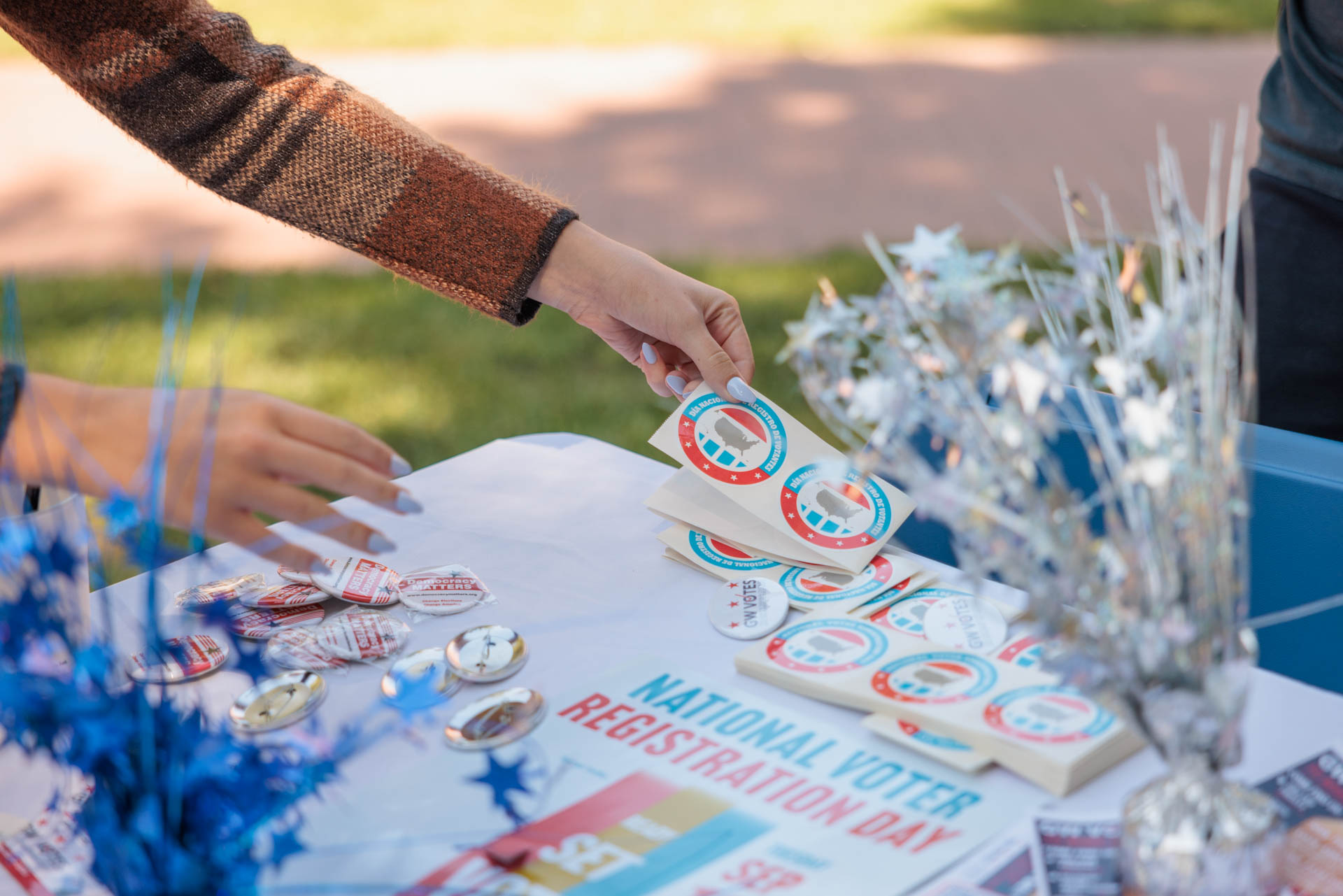


Michael Rodriguez, B.S. ’21, is program manager of GW Votes, a nonpartisan coalition of George Washington University faculty, staff and students (graduate and undergrad), formed to promote voter registration and civic engagement. GW Votes, launched in 2018, is a program of the Honey W. Nashman Center for Civic Engagement and Public Service.
Q: Why was GW Votes formed?
A: We’re here to support students in registering to vote, feeling prepared to cast their ballot and really just trying to tackle any barriers that students are facing in terms of voting. A lot of our students vote by mail. We have students voting across all 50 states and U.S. territories, and navigating the mail-in ballot process can be confusing, for first-time voters especially. It’s different across every state and territory, so you can’t always ask your roommate or your classmates if you have questions because they might have different deadlines and different legal requirements. GW Votes isn’t here to tell you who to vote for, but to make the voting process more accessible and a more fun part of people’s civic identity.
Q: What should students know going into the upcoming midterms?
A: The main thing is that a lot of times deadlines to register and to request a mail-in ballot are far in advance of Election Day. For the most part, you need to make your plan to vote early. And that plan will include answering the following questions: How do you register? Are you going to vote in person or by mail? Are you going to vote early if your state allows early voting? Who do you want to vote for?
Q: Given reports of unreliable websites pretending to help voters, what should voters be wary of?
A: You should know what sources to trust, and that can be challenging. But at least for GW students, we have a tool called GW TurboVote, designed specifically for members of the GW community. TurboVote is an online free platform for anyone. GW partners with it to have our own page.
Q: What is important for voters who may be voting in person to know? And for mail-in voters?
A: It’s important to know what your legal rights are as a voter before you go to cast your ballot so that you can be aware if something is infringing on your rights, if it is happening to you or someone else. And then you should know where to report it. There are hotlines that are available on Election Day and during early voting periods where you can report voter suppression or ask about your rights as a voter.
If you’re voting by mail or voting early, you should know how to contact your local elections office if you have any voting issues. Having their phone number or contact information is key. Anyone can reach out to GW Votes with questions, but if it’s really specific or unique, we’re going to tell you to contact your local elections office.
A lot of GW students vote by mail. We provide stamps for free and envelopes if students need them, because that can be a barrier. We have them at the Nashman Center (located at 2300 H St. NW), where GW Votes is housed. People can stop by during business hours if they want a stamp or with any voting questions. When we’re tabling around campus, we usually have stamps as well.
Some of our younger students may be unfamiliar with using traditional U.S. mail, so they should not be hesitant to ask us any questions about how to use it. Your ballot could be lost or not counted if you’re not addressing your mail correctly.
Q: What opportunities are there for people who want to be involved with GW Votes?
A: We have a voting ambassador program. If students want to get involved, we train them on how to talk about voting to other campus communities, to become our ambassadors to their student orgs or in their classes. We do classroom presentations, with students speaking for five minutes or so on the basics. Students can get involved if they want to help us table, and we meet monthly to brainstorm ideas about how to engage other students.
We also have a task force for faculty, staff and student leaders, trying to institutionalize voting across campus. GW is a huge university with many different facets, so we’re trying to get as much representation from different schools and different student organizations and faculty and staff as we can to help us brainstorm. We meet virtually once a month.
There is also a guide, a resource that was created by our GW Votes team designed for faculty and staff who want to incorporate voter engagement into what they do at the university. If you want something quick and easy, it has language you can copy and paste in your syllabus or in an email. There’s language on how to talk to students about voting, and there’s a way to request students to come to your class to talk about voting.