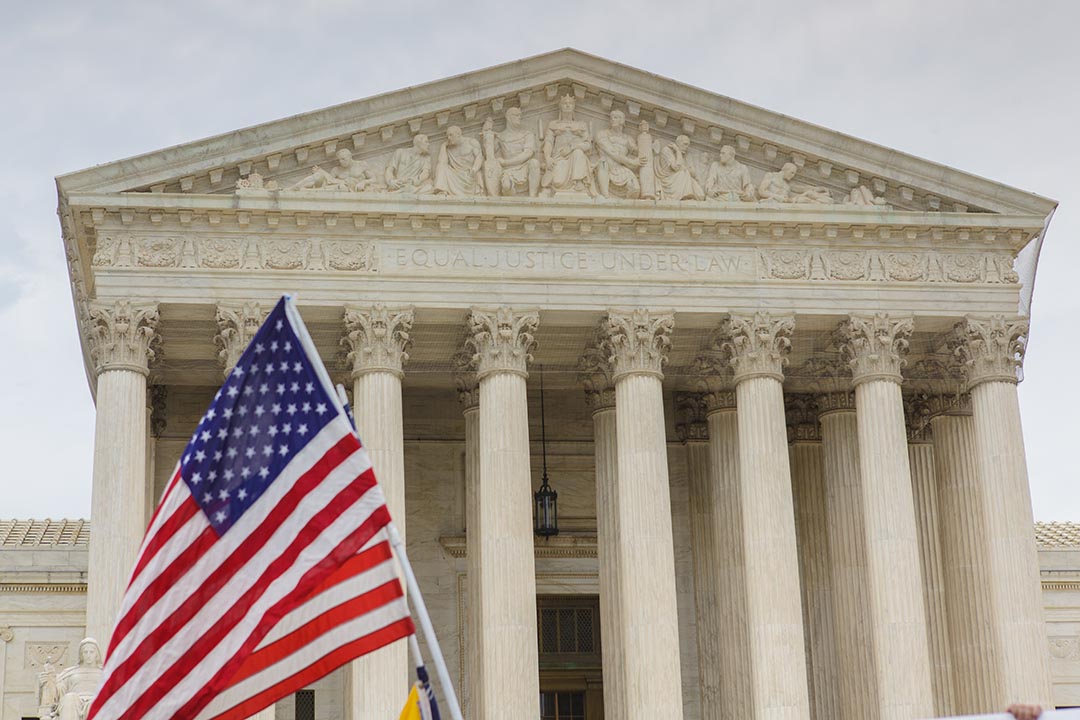


Questions before the U.S. Supreme Court this term include whether felony defendants in all 50 states are guaranteed 12-member juries and whether assault weapons are protected by the Second Amendment. These and other issues were discussed at GW Law’s annual SCOTUS preview held on or near Constitution Day, which commemorates the signing of the U.S. Constitution in September 1787.
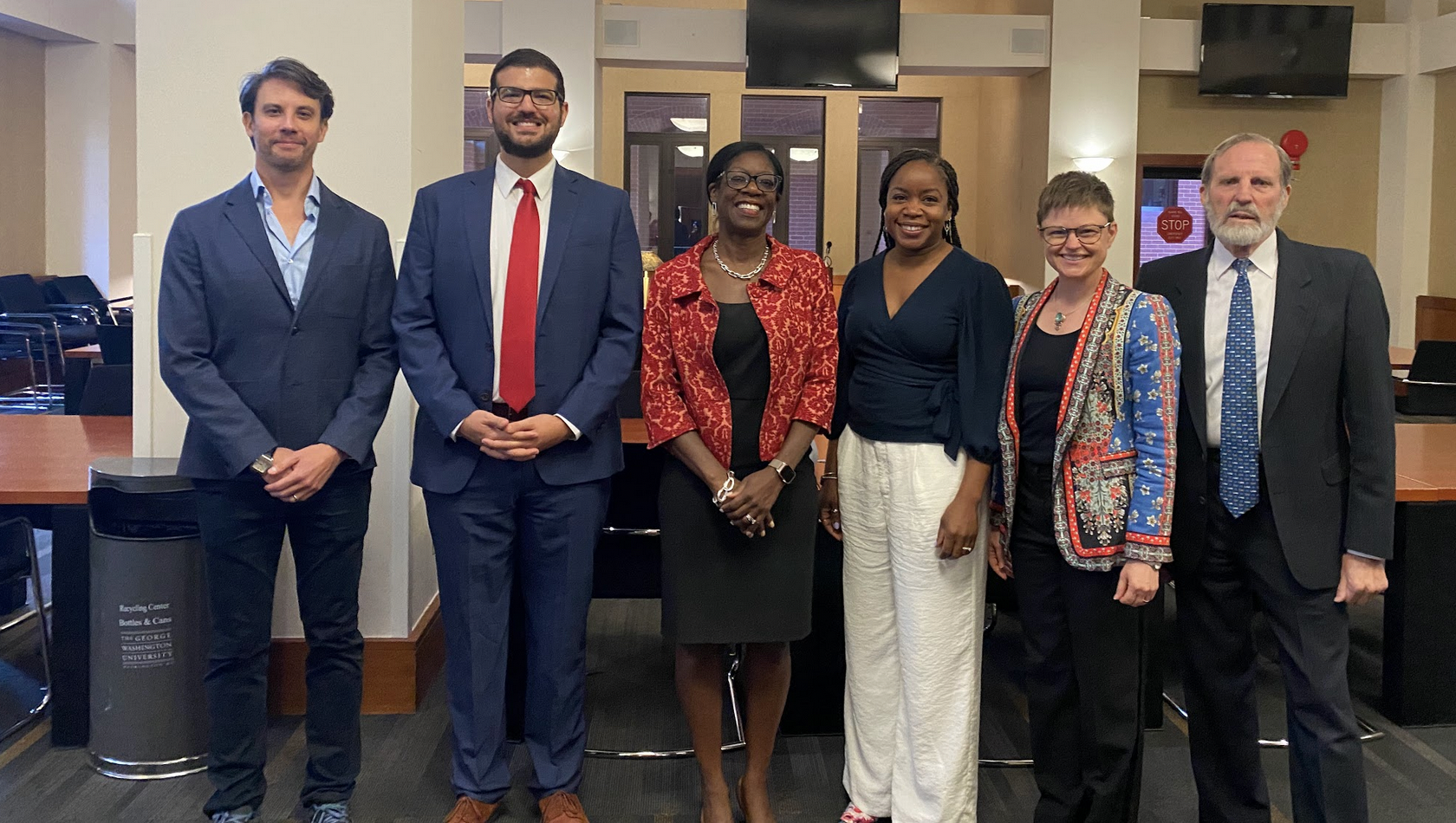
Moderator Chris Geidner, editor of LawDork, and a panel of four GW Law faculty members remarked on the pending cases before an audience of students and other observers in the Jacob Burns Moot Court Room. Faculty participants included Robert J. Cottrol, Harold Paul Green Research Professor of Law; Robert L. Glicksman, J.B. and Maurice C. Shapiro Professor of Environmental Law; Renée Lettow Lerner, Donald Phillip Rothschild Research Professor; and Alan B. Morrison, professorial lecturer in law.
Glicksman began with a brief discussion of Suncor Energy v. County Commissioners of Boulder County, an environmental law case stemming from a fire in Boulder County, Colorado, in 2021, which burned 6,000 acres of land and destroyed about 1,000 homes. The county brought suit to be reimbursed for the costs incurred on the theory that the wildfire was made more likely and more severe because of climate change caused by fossil fuel products.
“In addition,” Glicksman said, “Boulder County is arguing that the oil companies committed fraud. The theory is that the companies knew decades ago that their products when consumed generate greenhouse gases that would contribute to climate change. They knew what the adverse effects of climate change were likely to be, and they actively suppressed information so that it wouldn't be made public.”
The energy company argues that Boulder’s ability to recover damages is preempted for various reasons by federal law. For example, ruling in favor of Boulder County would make it less likely that the law companies would be willing to continue to market their products in the U.S.—something that the federal government, not the state, should be able to control.
“It’s hard to predict how the court’s going to come out,” Glicksman said, adding, “This court has not been a friend of environmental law, to say the least.”
Geidner expressed concern about the so-called shadow docket, which allows cases to be brought before SCOTUS on an emergency basis. The shadow docket has been criticized for its acceleration of normal legal processes and its lack of transparency. In a recent example, the court allowed the Trump administration to go forward with construction of a ballroom at the White House. Some justices have signaled that they’re uncomfortable with the frequent use of the shadow docket.
“The problem,” Geidner said, “is that things are happening so quick, on an abbreviated schedule, without argument in most cases, and they’re happening before parties and outside parties who would file amicus briefs have time to really develop their arguments.” The result, he added, is that “things are happening that just shouldn’t be happening.”
“Partisan politics has nothing to do with it,” Morrison joked.
“It doesn’t have everything to do with it,” Geidner said. “Some of it is the timing. If you’re moving quickly, you are going to break things sometimes. And so there are going to be unintended consequences.”
Cottrol discussed two Second Amendment cases, including Viramontes v. Cook County, which asks if an individual’s right to own semiautomatic rifles is constitutionally protected. He began by drawing attention to the peculiar fact that the Second Amendment, though ratified by the states in 1791, wasn’t the subject of much court action until more than 200 years later.
“Basically, the Second Amendment goes on for two centuries without any really definitive definition of what it means,” Cottrol said. “The 21st century becomes the century of the Supreme Court looking at the Second Amendment and engaging in Second Amendment activism.”
The reigning doctrine of the Second Amendment comes from the 2022 case of New York State Rifle and Pistol Association v. Bruen, which introduced a new test for gun regulation.
“Typically, before Bruen, the court has used various kinds of balancing tests, looking at the right allegedly infringed and the interest of the government-aligned entity that is supposedly infringing the right,” Cottrol said. “With Bruen, Justice Thomas announced a new methodology, which is to look at the history and tradition of firearms regulation, particularly as it existed at the time of the enactment of the Second Amendment in 1791, to see if a particular regulation is consistent with that history.”
One of the best indications of what the framers thought about military weapons, Cottrol said, was that they required them in the National Firearms Act of 1792, mandating that every white man own a rifle and a bayonet. The idea that military-grade weapons are outside of the protection of the Second Amendment contradicts the amendment’s actual purpose to ensure a citizen militia.
Renée Lettow Lerner offered remarks on Kian v. Florida, a case asking if felony defendants are guaranteed a 12-member jury under the Sixth Amendment. While most states have such criminal juries, there are six states that do not. A landmark SCOTUS ruling in 1970 in Williams v. Florida held that the Sixth Amendment does not require 12 members on a jury. But if the court rules in favor of Kian, many cases would have to be retried.
“In the good old days of the common law, there were lots of incentives for jurors to find unanimity quickly,” Lerner said. “First of all, a lot of jurors were repeat players. They sat on more than one jury. They sat quite a bit, so they were very familiar with the justice system. There were property requirements to serve on a jury. So these were people who knew each other. That makes it easier to achieve unanimity.”
There was no voir dire process to vet potential jurors, Lerner added, and judges frequently commented on evidence to juries. Most strikingly, she said, jurors were not allowed food, drink, heat or light from the time they were sworn in until the time they gave their verdicts.
“It’s great to have 12-person unanimous juries, but look what the common law had to do to make that efficient. And if you don’t do it, you get hung juries,” Lerner said. “In the end, what you get is fewer juries because there will be even more intense pressure for prosecutors to offer plea deals and more pressure for defendants to accept them.”
The panel concluded with a question-and-answer period after Morrison briefly discussed a pending voter registration case, Republican National Committee v. Mi Familia Vota, asking whether Arizona state voting requirements clash with federal requirements. The case will not be argued until December, after the upcoming midterm elections, Morrison said, but could have a major impact moving forward.