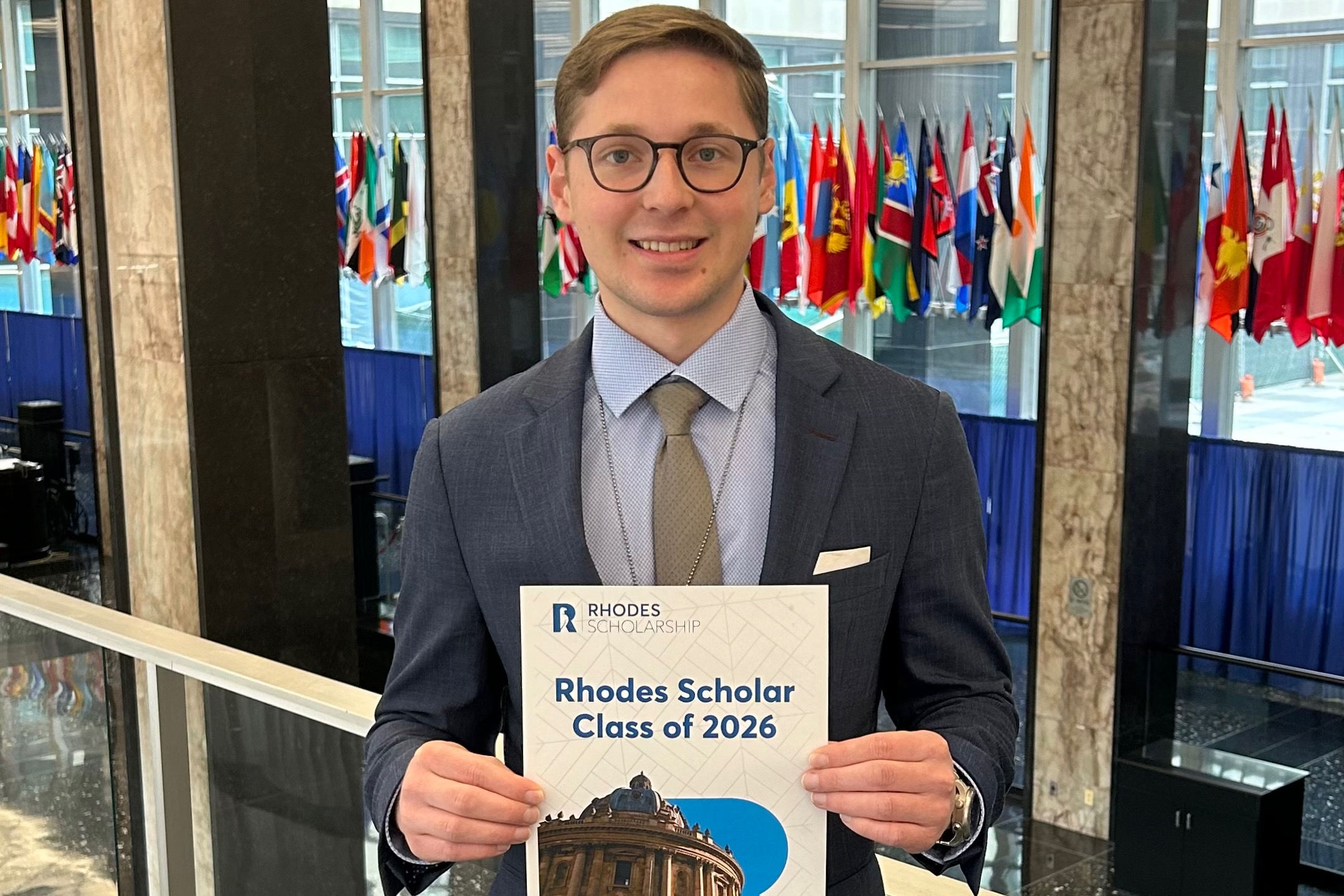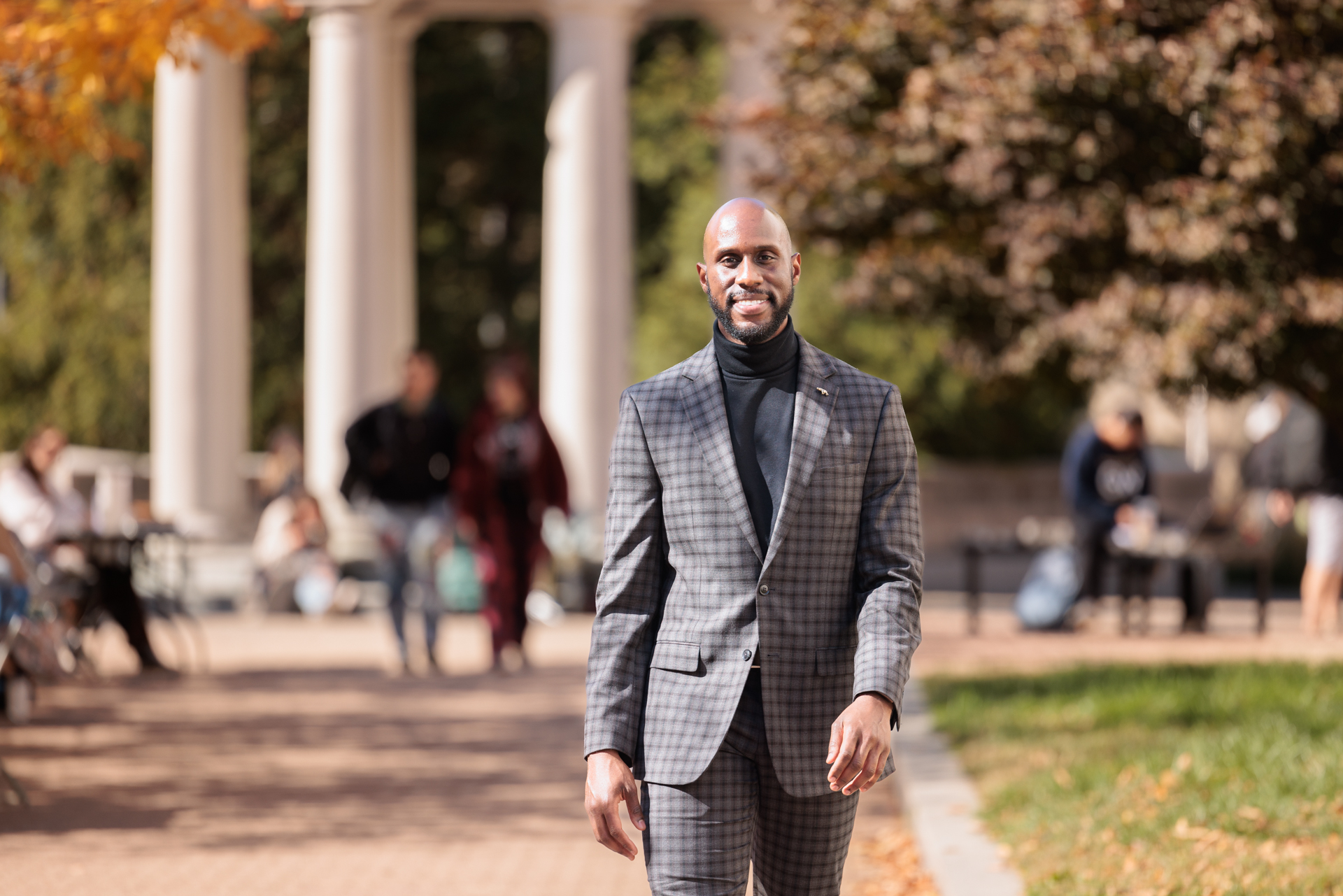


Rising senior Eve Danishevsky has had a banner year. She recently became the first George Washington University student to be awarded a Beinecke Scholarship, worth $35,000 in support of her future graduate education, and before that was awarded the Obama-Chesky Voyager Scholarship for public service.
Since the Beinecke Scholarships were first given out in 1975, nearly 775 students have received these awards, intended to offer substantial support to graduate scholars of exceptional promise. The Sperry Fund administers the program.
The Voyager Scholarship, created by Barack and Michelle Obama and Brian Chesky, co-founder and CEO of Airbnb, is designed to help scholars launch public service careers. It provides financial aid for educational costs and offers Airbnb credits worth $4,000 to assist with travel expenses.
Danishevsky is spending time this summer in Uzbekistan, furthering her expertise in Central Asian culture. Jacob English, director of the Center for Undergraduate Fellowships and Research (CUFR), guided her through the application process for the Beinecke Scholarship, but first became aware of her when she submitted a successful application for an Undergraduate Research Award (URA), which helps cover costs associated with her research as a Dean’s Scholar in the Elliott School.
“Eve is a shining example of a young scholar who has made the most of the GW and D.C. resources available to her,” English said. “I truly believe that GW is a place where students can accomplish incredible things when initiative is met with support, mentorship, opportunity and a willingness to take steps toward their goals and ask good questions. Eve has taken those steps and asked those questions. I know this is just the beginning of her flourishing academic journey.”
Danishevsky said she is grateful for English’s help throughout the Beinecke application process. She first thought of applying for the scholarship when she noticed it while scrolling through the CUFR website in search of any opportunities she might be eligible for. After preliminary interviews, she started a series of monthly meetings with English to shape her application.
“It’s been so great working with him,” Danishevsky said. “He helped me tell my story in a comprehensive way, in a strong narrative about who I am as a person and my work as a hopeful scholar of Central Asia.”
Previously, she said, as a first-generation college student, she hadn’t been confident that grad school was an option.
“I come from a low-income background,” she said, “and I never really expected to even think about doing a Ph.D., but Dr. English has been incredible, sitting down with me and talking through my plans, and being so encouraging about taking these leaps of faith and applying for these programs.”
English expressed gratitude in turn for the members of the Beinecke Scholarship endorsement committee, consisting of GW faculty and staff including Amy Cohen, assistant vice provost and executive director of the Honey W. Nashman Center for Civic Engagement and Public Service; Gabby Headrick and Scott Quinlan of the Milken Institute School of Public Health; Kristen Luck of GW Libraries and Academic Innovation; David Rain, associate professor of geography and international affairs in the Columbian College of Arts and Sciences; and Erin Speck, assistant professor in the Interior Architecture Program of the Corcoran School of the Arts and Design.
“CUFR is a small but mighty office,” English said, “and we rely heavily on the service, expertise and care of the wonderful GW faculty and staff who support our coordination of GW’s institutional endorsement process.”
Apart from the financial support for graduate school, Danishevsky said, the Beinecke Scholarship gives her access to a large community network of former Beinecke scholars, who can give tips for writing essays on graduate program applications, negotiating aid, and provide other kinds of support and encouragement.
The Voyager Scholarship, too, provides a supportive network for its awardees. The scholarship offers up to $50,000 to assist Danishevsky in her junior and senior years at GW. It will allow her to graduate debt-free, she said. In a stroke of luck, she learned about the scholarship the day before applications were due.
“I was just scrolling when I saw it,” she said. “There was no letter of recommendation requirement but there were some essays that I had to write, so I wrote about central Asia, international education and all of these interests that I have, and then I submitted it minutes before the deadline.”
Her interest in Central Asia goes back to her childhood, she said. Growing up in Philadelphia, she encountered many immigrants from the region and became fascinated by its history and languages.
“When it was time for me to sit down and actually think about what I wanted to do for the future,” she said, “I realized there’s a lack of Central Asian specialists, so I applied to the Elliott School of International Affairs. I would love to dedicate the rest of my life to this. Everybody has their little niche, and I’m very lucky to be able to focus so intensely.”
She is currently in Tashkent, the capital city of Uzbekistan, home to about 3 million people. When Uzbekistan was in the former U.S.S.R., Russian was the main language, but there has been a shift toward the national Uzbek language, Danishevsky said. She is focusing on international education, and in particular the effects of the termination of USAID and other kinds of U.S. funding on the educational landscape, and will be speaking with various educators and administrators.
Later this summer, using funds made available through her URA, she will spend additional time in the region doing library research on how ancient tribal systems of governance continue to impact modern politics in Central Asia.
“I’m really interested in the social factors involved in the proliferation of authoritarianism,” Danishevsky said. “Why are these regions so authoritarian? Of course, there are many economic reasons, political reasons and ideological reasons. But the one part that hasn’t been studied involves the social relations that are embedded in Central Asian society.”