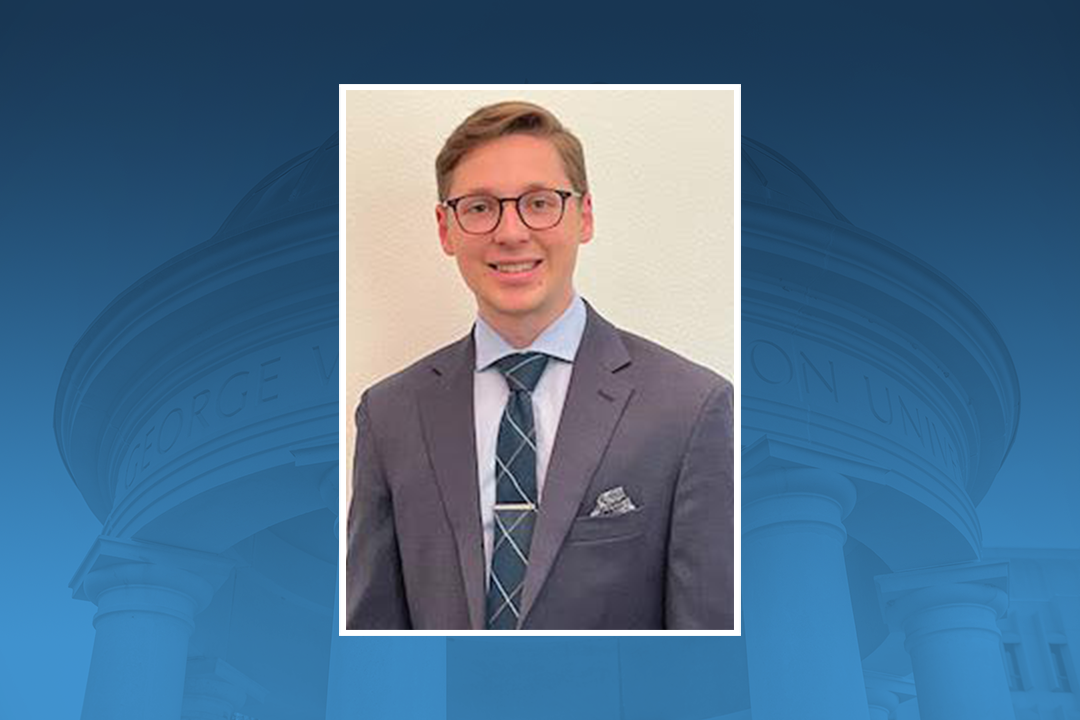

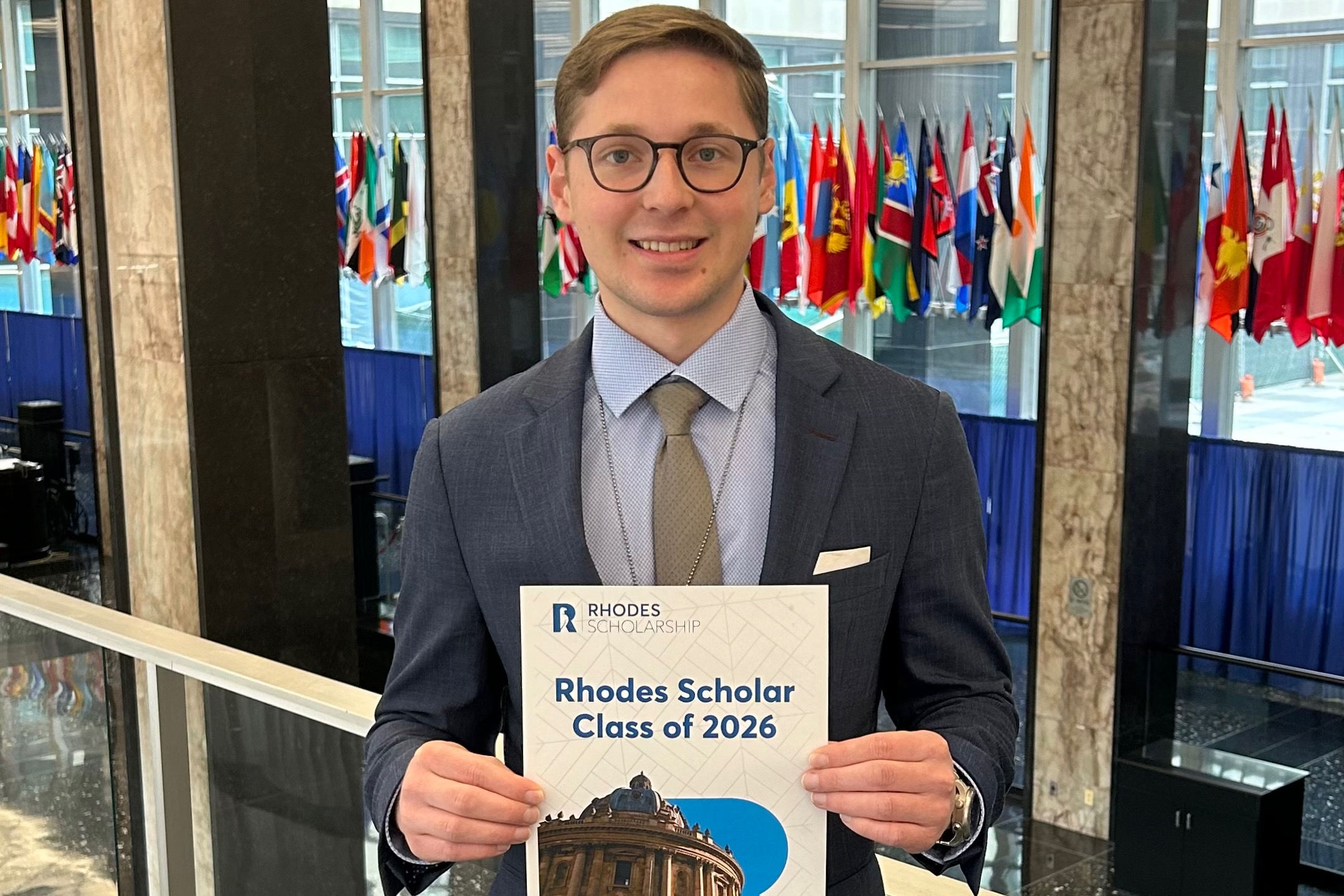
A book can change the world. When Andrew Tomusiak, B.A. ’24, was in the eighth grade, he happened upon a book about the Rwandan genocide and has since been dedicated to pursuing a career in peace and conflict studies. As a 2026 Rhodes Scholar, Tomusiak will work toward a master’s degree in public policy and an M.Sc. in global governance and diplomacy at the University of Oxford in England.
The book that inspired Tomusiak to work for world peace was “Shake Hands with the Devil: The Failure of Humanity in Rwanda” by Roméo Dallaire, who commanded the United Nations Assistance Mission for Rwanda.
“I discovered it on my dad’s bookshelf without knowing anything about the genocide,” Tomusiak said, “and became horrified by how the world had failed to protect human life in Rwanda, but simultaneously inspired by the courage of the peacekeepers and everybody who tried to drive reforms afterward.”
Tomusiak earned his bachelor’s degree in the Elliott School of International Affairs, where he was a Dean’s Scholar, also earning GW-wide distinction as a 2024 Distinguished Scholar. Over a period of six months, entailing multiple revisions of his application essay and participating in mock interviews, he was guided through the process of applying for the Rhodes by Jacob Alan English, director of the Center for Undergraduate Fellowships and Research (CUFR).
“Andy came to every one of our conversations prepared, curious and open to feedback, yet confident enough to push back respectfully to ensure the final application remained rooted in his own voice, agency and values,” English said. “That thoughtful balance of humility and conviction is exactly what the Rhodes Trust seeks in its scholars. His achievement shines within one of the world’s most selective competitions.”
After throwing his hat in the ring for the scholarship, Tomusiak said, he was pleasantly surprised by the results. He feels “deep gratitude” for the assistance of English and CUFR and would encourage interested students to apply.
“I feel incredibly lucky to have access to GW’s amazing community of faculty and mentors,” Tomusiak said. “It inspires me to work harder and try to make the world, or at least some small corner of it, a place where at the end of the day there's greater human freedom and dignity.”
Speaking of the technical aspects of conflict resolution, Tomusiak said it’s necessary to understand the interests of the different actors involved. Attention must also be paid to unintended consequences of any sort of intervention.
“At the same time, there's a soft skill angle of it too, which I think is rooted in empathy,” Tomusiak said. “Not just trying to understand on an academic level, but really putting yourself in the shoes of whoever’s sitting at the table and trying to understand what sorts of solutions will work at a human level.”
For his Dean’s Scholars thesis, Tomusiak created a database to learn about why regime leaders pardon failed coup plotters. His awareness of the importance of the human factor in all of these equations was bolstered in one of his favorite classes at GW, a course on transitional justice taught by Elvira-Maria Restrepo.
“It helped me see how all policy should be rooted at a basic level in what allows people to reconcile and build cohesion within their societies. Conflict is inevitable in all human societies, and that’s why it’s so important to build strong institutions to resolve conflict so that it doesn’t escalate to violence,” Tomusiak said.
After graduating from GW, Tomusiak joined the U.S. State Department as an analyst in the policy directorate at the Office of Foreign Assistance Oversight. There, he said, he has seen how tools of national power can be used to push toward a convergence between national interests and the betterment of humanity, as well as the pitfalls that can undermine this convergence.
“In the wake of the shutdown of USAID this year, I think the U.S. should take advantage of an opportunity to rethink how we approach our policy toward developing and conflict-affected countries with the benefit of decades of hindsight, and I wanted to gain the best skills possible to be able to contribute to building what this next chapter might look like,” he said.
With a service commitment running through 2032, Tomusiak is an intelligence officer in the U.S. Army Reserves. During his time in England, he hopes to be able to serve at the joint U.S.-U.K. base, RAF Molesworth.
“I want to gain the insight and analytical abilities and perspective from practitioners who’ve solved complex problems in Britain and around the world,” Tomusiak said, “and bring some of those lessons back to the State Department and work to make U.S. foreign policy more strategic, effective and ethical.”
GW was the perfect school for him, Tomusiak said, because it attracts so many students who want to create new knowledge that can then be used to create change, and because there are so many skilled mentors here who stand ready to help.
“It’s not in a vacuum that you try to make good policy,” Tomusiak said. “It's in a really complex political environment, with so many different actors and interests, and to figure out how to make the world a better place in that environment requires a particular set of skills. GW stood out to me as the place that would help me learn those skills.”