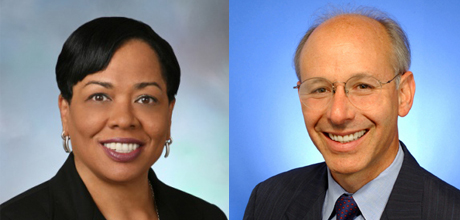


In March, the George Washington University Board of Trustees elected Mark Chichester, B.B.A. ’90, J.D. ’93, as chair; Todd Klein as vice chair; and Jeffrey Flaks, M.H.S.A. ’96, to continue serving as secretary.
They are tasked with leading as the university as it enters a pivotal new chapter, marked by the launch of its strategic framework and its recent admission into the prestigious Association of American Universities (AAU). Before they assume–or in Flaks’ case continue–their elected positions on June 1, each answered questions from GW Today on the opportunities ahead for the university, the evolving landscape of higher education and their vision for GW’s future impact in Washington and around the world.
Mark Chichester
Q: As you step into the role of chair, what excites you most about leading GW’s Board of Trustees at this moment in the university’s history?
A: It is a committed board of diverse talents, laser-focused on helping the university reach its fullest potential. And if there is a silver lining in these chaotic times, it is that there is an opportunity to reimagine the future with GW playing a key role in helping bring about that future.
Q: Your career spans health, international affairs and nonprofit leadership. How will those experiences shape your vision for GW?
A: My cross-sector experience, which includes a few entrepreneurial pivots, reinforces a consistent lesson: organizations succeed when they remain mission-driven and forward-looking while adapting confidently to change. That perspective will shape my continuing service to the university.
Q: As a double alumnus, how has your personal connection to GW influenced your approach to this leadership role?
A: Simply stated, GW changed my life. If I can be helpful in ensuring that the university continues to thrive such that it can do the same for others, then I will have begun to pay back the debt I owe.
Q: How do you see the board partnering with university leadership to advance GW’s strategic framework and standing as an AAU institution?
A: The strategic framework is a reflection of the collective aspirations of the GW community, and the board will partner with the administration and our world-class faculty to keep the focus on that north star. We will contend with the inevitable challenges that are beyond our control as they come, but remain focused on our shared vision for preeminence as we chart GW’s unique path as an AAU institution.
Q: What opportunities do you see for GW to strengthen its role in Washington, D.C., and on the global stage?
A: GW plays a major role in the city as a top employer, provider of healthcare and engine of economic activity. GW’s annual economic impact is estimated to be upward of $1.5 billion. There are opportunities to more tightly align university research with the needs of the region, and GW will continue to seek ways to expand its global reach and impact through teaching and research.
Todd Klein
Q: What excites you most about stepping into the vice chair role on GW’s Board of Trustees at this time?
A: We are in a moment when universities are being asked not just to educate students but to help solve real-world problems and model constructive dialogue. Given our resources and location, we are uniquely positioned to lead in all of these dimensions.
Q: You’ve helped build and invest in more than 150 companies. How can your entrepreneurial perspective inform GW’s future growth and strategy?
A: Startups teach you to focus relentlessly on mission, talent density and most importantly, adaptability. The most nimble organizations stay intellectually curious, do not get stuck in dogma, move quickly when opportunities emerge and aren’t afraid to rethink old assumptions. Ultimately, if GW could emulate a startup's ability to iterate its decisions as a matter of habit, our entire community would be well-served.
Q: Having worked across technology, media, healthcare and education, where do you see the greatest opportunities for innovation at GW?
A: The biggest opportunities are at the intersections of seemingly distinct disciplines such as AI and healthcare, policy and technology, or entrepreneurship and public service. Our strength is that we already bring together disciplines that too often operate in silos elsewhere.
Q: Given that you helped launch the Global Food Institute at GW, how do you see cross-disciplinary initiatives like that shaping the university’s future?
A: The world’s most important challenges aren't confined to a single academic department. Food, climate, health, security and economic mobility are deeply interconnected. Universities that can convene experts across fields and disciplines and focus on real-world problems will have outsized impact.
Q: How can GW better prepare students to thrive in a fast-moving, startup-driven and technology-focused economy?
A: The rapid adoption of technology, social competition, global uncertainty and other factors are all affecting students in unprecedented ways and at a breathtaking velocity. In this environment, students need adaptability, judgment, communication skills and the confidence to navigate ambiguity just as much as they need technical skills. GW attracts and nurtures students who learn continuously, collaborate across disciplines and turn ideas into execution.
Jeffrey Flaks
Q: As you continue your service as secretary, what excites you most about this next chapter for GW and its Board of Trustees?
A: What excites me most is the opportunity to continue serving an institution that truly changed the course of my life. My time at the George Washington University shaped not only my professional journey but also my understanding of leadership and purpose, driven by service to others. I carry a deep sense of gratitude for the education, mentorship and experiences I received at GW, and it’s a privilege to serve on the board in a way that advances the best interests of the university and its community.
I’m also incredibly energized by President Granberg’s vision for the future of GW. Her bold thinking, intellectual curiosity and commitment to innovation are exactly what higher education needs in this moment. The initiatives underway, together with the university’s new mission, strategic framework and brand refresh, create a clear sense of direction and alignment. They position GW to drive transformational impact — not only within the institution, but across the broader role universities play on the national and global stage. It is an honor to support that work alongside such an accomplished and dedicated Board of Trustees.
Q: You’ve led large-scale transformation in healthcare systems. How will that experience inform your contributions to GW’s governance and strategy?
A: Healthcare today is undergoing profound transformation — driven by advances in technology and AI, changing consumer expectations, workforce evolution and the imperative to improve access, affordability and outcomes. Leading through that kind of complexity requires clarity of mission, a willingness to innovate and the courage to think differently about the future.
Many of those same dynamics are reshaping higher education. Institutions like GW have an extraordinary opportunity to reimagine how they prepare students, advance research and create meaningful societal impact. My experience leading transformation in healthcare has reinforced the importance of strategic partnerships, interdisciplinary collaboration, operational agility—along with maintaining a relentless focus on people—whether patients, students, faculty or the communities we serve.
I hope to bring a perspective grounded in innovation, systems thinking and long-term stewardship as GW continues to strengthen its role as a leading academic and research institution.
Q: As a GW alumnus, how does your experience here shape your commitment to the university’s future?
A: GW opened doors for me that fundamentally changed my life. Pursuing my Master of Health Administration expanded my worldview and deepened my understanding of how leadership, grounded in service to others, can improve lives and strengthen communities. The education I received helped shape the trajectory of my career and instilled values that continue to guide me every day. GW challenged me to think bigger, to lead with purpose and to embrace the responsibility that comes with serving others. That experience creates a deeply personal connection to the university and a strong commitment to its future.
Q: You’ve championed innovation through partnerships with companies such as Google and Amazon. How can GW expand similar collaborations in research and education?
A: Partnerships can create powerful opportunities to accelerate innovation, expand an organization’s capabilities, execute faster and better prepare students for a rapidly changing world.
GW is exceptionally well positioned to lead in this space because of its strengths across so many disciplines—medicine, public health, policy, technology, business and global affairs. That interdisciplinary foundation fosters collaboration that bridges academic excellence with real-world application, creating new opportunities for experiential learning, cutting-edge research, AI advancement, healthcare innovation and workforce development.
What matters most is ensuring that every partnership remains anchored in mission and purpose. When universities and industry come together thoughtfully and responsibly, the impact can be profound—driving real progress for students, communities and society as a whole.
General questions
The new officers also answered additional questions about the future of GW and how the board will support the university’s core values and mission in an ever-evolving landscape.
Q: As the university continues to implement its strategic priorities, where do you believe the board can have the greatest impact?
A: Among the most important roles of the Board of Trustees is that of ensuring there is strong and consistent leadership atop the institution. We have an extraordinary leader in Ellen Granberg, and we are excited to continue to partner with her to meet the challenges and seize the opportunities that lie ahead in this moment of disruption and uncertainty for higher ed. Despite the unsettling nature of the times in which higher education finds itself—GW being no exception, we must strive to find opportunities to turn uncertainty and adversity to advantage. The board can have its greatest impact by ensuring that the university maintains its focus on the strategic framework while remaining agile and opportunistic as we lean into the future.
Q: What does success look like for GW students over the next decade, and how can the board help support that vision?
A: We are living in a time of generational change and disruption, and success for our students will depend upon their ability to acquire critical reasoning skills, leverage new technology, and develop adaptive capacity and resilience that will define their life success. The strategic framework speaks directly to this question. I would refer you to it and would add that I believe that we have an obligation—as the national university named for America’s founding president—to produce educated and informed citizen-leaders, not just able consumers.
Q: Looking ahead, what is one bold idea or area of innovation you believe GW should embrace to remain competitive among leading universities?
A: We have to be prepared to ask hard questions, to seek answers to those questions and to set the foundation for a strong future while honoring the best of our past. Things that we might have considered bold a few years ago are necessary today. With that said, we have an opportunity to differentiate by anticipating and shaping the AI-enabled future. Again, we would refer you to the strategic framework, which is our north star.
Q: GW has a strong alumni network—how do you hope to engage that community in advancing the university’s mission?
A: We have very strong administrative leadership in this area, and we’re already seeing the returns on the investment in that talent and experience. My belief is that we are only as strong as our connectivity to, and the quality of engagement with, alumni. We must invest accordingly and continue to improve the student-to-alum experience lifecycle.
Q: What challenges facing higher education today do you think GW is uniquely positioned to address?
A: Not just higher ed, but broader society, is being reshaped by the rise of AI and other technologies. Candidly, the public sector is behind the curve in anticipating and preparing for the coming impacts. GW can and will play an important role in teaching and research in this area and in preparing a new generation of leaders to answer hard questions about the future of knowledge, work and the social contract.