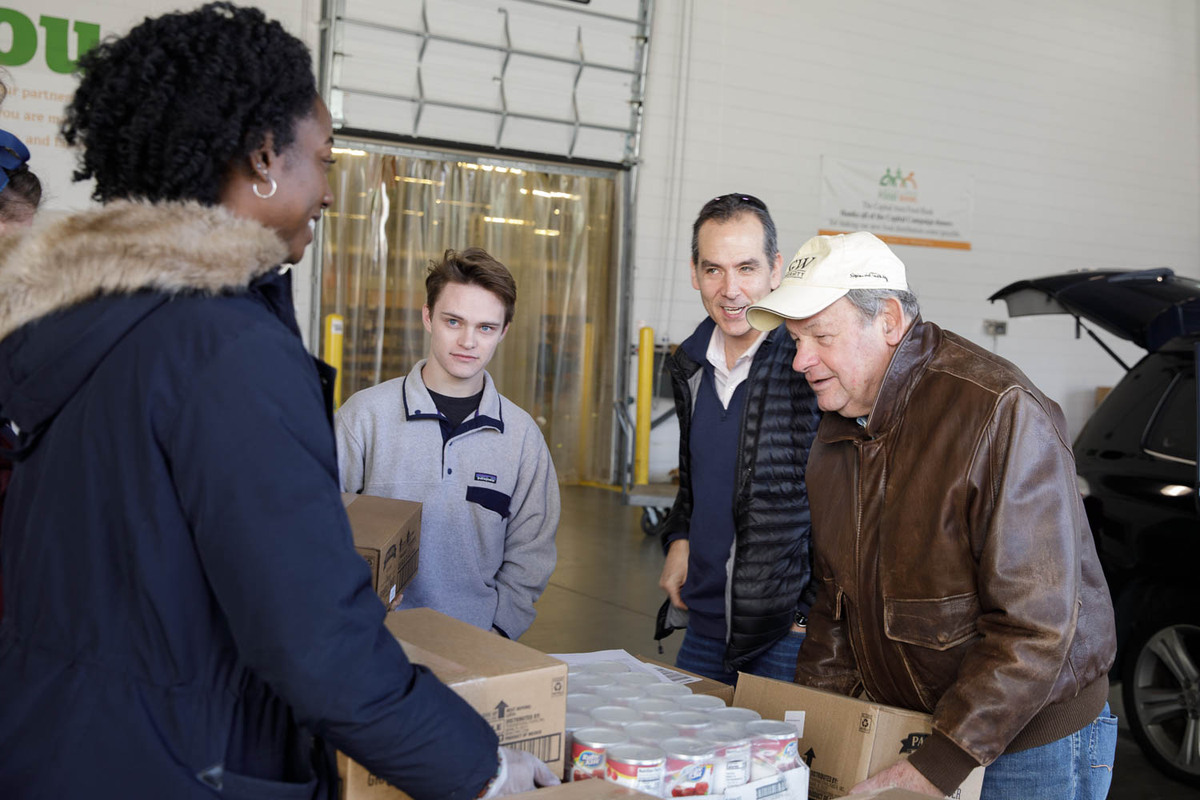


The George Washington University cohosted the 2026 Regional College Hunger Conference Oct. 6 alongside the Capital Area Food Bank and the Consortium of Universities of the Washington Metropolitan Area. Established in 2022, the conference brings together researchers, advocates and higher education leaders in the Washington, D.C., area to examine the landscape of hunger in education and explore best practices to support students experiencing food insecurity.
“For five years running, this conference has brought together leaders and experts to advance critical conversations about ways to support college students experiencing food insecurity,” GW President Ellen Granberg said in a video message filmed at The Store, GW’s on-campus food pantry.
The Store, which this month marks a decade in operation, is “one of the primary ways the university supports the essential needs of our students,” Granberg said. “GW is grateful for our longstanding partnership with the Capital Area Food Bank, which helps make this incredibly important campus resource possible.”
Granberg also thanked attendees for their “ongoing work to build paths out of food insecurity.”
“We're here today around a fundamental truth: Academic success is impossible when the basic needs of our students go unmet,” Vice President for Student Affairs and Dean of Students Colette Coleman said in her opening remarks. “At GW, addressing food insecurity is not just an administrative priority; it's a core expression of our mission and our values.”
The conference was emceed by Andrew Flagel, B.A. ’90, M.A. ’94, president of the consortium. Flagel said he, too, experienced food insecurity and the importance of community support as a student. When a financial crisis in his family left him “not able to have consistent meals,” food service workers who knew him from his student job in a dining hall reached out, ensuring not only that he remained fed and healthy but that he stayed enrolled.
Flagel’s anecdote pointed to the ways hunger can derail an education, a link local higher education leaders have seen firsthand. Two D.C.-area college presidents—Gregory Washington of George Mason University and Jermaine F. Williams of Montgomery College—discussed the issue in a morning panel along with Al Campbell, president and market leader of Holy Cross Health Maryland, and Maggie Moran, senior manager of strategic planning and business operations with Amazon University Talent Acquisition.
The panel was moderated by J.B. and M.C. Shapiro Professor of Media and Public Affairs Steven Roberts, who in 2020 endowed the Roberts & Segal Fund for Food Security with former student Ted Segal, B.A. ’03, and his wife Meredith Segal, B.Accy. ’05.
Education is a changemaker not only for an individual but also for their community and their society, Williams said. That means the ripple effects of attaining educational success—or being barred from it—can be enormous. And food insecurity has a powerful effect on a student’s mental and physical health, Williams said, “severely decreas[ing] the likelihood that someone is going to…accomplish [their] educational goals.”
The problem doesn’t suddenly arise in college, as Williams pointed out. In Maryland’s Montgomery County, where Montgomery College is located, nearly a third of households have experienced food insecurity in the last year, he said. In the DMV more generally, that number rises to nearly 40 percent of households.
“These are individuals attempting to engage in our workforce, to contribute to our society,” Williams said. Both they and the communities in which they live suffer the consequences of their exclusion.
Washington pointed out that students may not even recognize their own food insecurity until it hits a tipping point. He didn’t during his own college years, even though “there were times when [he] was struggling to find meals”—appealing to friends or slipping into organizational meetings in the hopes of scrounging free food.
“I was actually food insecure and I just didn't realize,” Washington said. “And there are thousands of students who are in that boat right now.”
But the facts can become undeniable. At George Mason, Washington recalled, a confluence of circumstances once led to the university’s food bank running out of food. Washington said he and his staff had to reach out to local food banks, expand the university’s network of partnerships and adjust budgets to address the crisis.
During that time, he said, faculty and administrators also “saw a drop in performance” that suggested “there's something that those young people are supposed to get that they're not getting.”
“It was an awakening for our campus,” Washington said. “Food is not an auxiliary enterprise; food is a necessity.”
The day also included first-person testimony from local students about their own experiences of food insecurity, including Milken Institute School of Public Health graduate student Sophia Lindsay.
Among the day’s breakout sessions was a workshop run by Priya Fielding-Singh, director of policy and programs of GW’s Global Food Institute, and Gabby Headrick, a faculty member at Brown University, based on a new toolkit Fielding-Singh and Headrick co-authored in partnership with the nonprofit Swipe Out Hunger.
Workshop participants from two- and four-year institutions as well as nonprofits worked through the toolkit’s human-centered design approach, which engages students as co-designers in developing solutions to campus hunger.
Running the workshop on a college campus, said Fielding-Singh, begins with framing a specific challenge, identifying who needs to be in the room, and considering the resources and other factors that could help participants develop solutions grounded in students’ experiences.
Approaching the problem with empathy is key to the process, Headrick explained.
“You actually need to work directly with folks who are experiencing the problem to understand from their lived expertise and experiences what it is that needs to be built out for those problems to no longer exist,” she said.