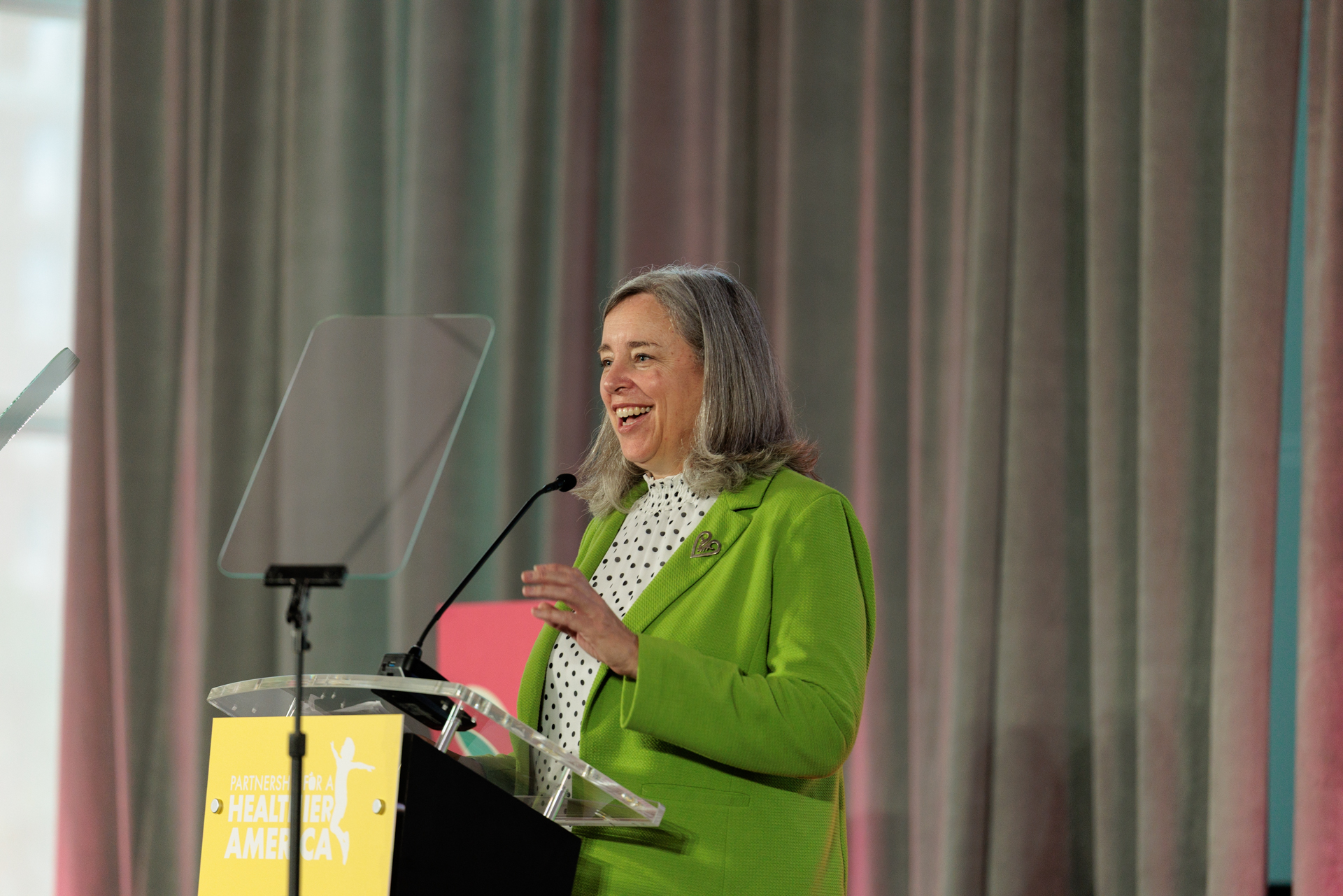


The Partnership for a Healthier America (PHA) and the George Washington University’s Global Food Institute (GFI) hosted the second annual Good Food for All summit at GW June 10, welcoming hundreds of local and national leaders, health professionals, food experts, policymakers and members of community organizations to discuss the connection between access to good food and health.
Opening the summit in the University Student Center’s Grand Ballroom was Laurie Anderson, director of social impact at Instacart, a summit sponsor that she said delivered 10 million servings of fruits and vegetables to families across the country this year.
“This reflects a shared conviction,” Anderson said. “Food access is about whether people can realistically access healthy food and afford it, will actually consume it and whether it fits their schedules, their budgets and the realities of their daily lives.”
PHA President and CEO Noreen Springstead and GFI Carbonell Family Executive Director Stacy Dean discussed “The State of the Plate: 2026 and Beyond.” Dean credited the administration with “advancing and fueling a conversation” that tapped into people’s desire to know about healthy food.
But the messages, she said, were in contrast with federal economic policies that cut Supplemental Nutrition Assistance Program (SNAP) benefits for more than 3 million households.
“I’m looking around the room, and I see Urban Food Alliance, D.C. Central Kitchen, Fresh Farms, these great leaders who are doing incredible work in our communities,” Dean said, urging them to scale up their efforts. “We are programming around a failed system. There are communities that just don’t have access to affordable food.”
Springstead described national and local food programs, including Instacart’s Good Food at Home, as as beacons of hope:“food companies that are doing well doing good.” Other signs of progress included the healthy corner stores movement and PHA’s own work with grocery stores and farmers in the Mississippi Delta.
“There’s now a turn of the tide that says health can move market dollars, move products, put food into carts, onto plates and fuel social impact,” she said.
The keynote speaker was food writer Mark Bittman, former New York Times columnist and cofounder of Community Kitchen, a project based in New York City’s Lower East Side aimed at providing nutritious food at affordable prices. He spoke with U.S. Rep. Jim McGovern (D-Mass.) who has fought to protect school meal programs, SNAP and other programs for low-income Americans.
McGovern began by noting, “It is one thing to talk about a [commitment to healthier food for everybody]. It is another thing to support policies that make that happen.”
He asked Bittman about the most significant changes he’d seen in four decades of writing about food.
“The change in rhetoric has been nice,” Bittman said. “It has gone from individual personal responsibility to how do we make the right choice, the easy choice…[to]access to good food should be a universal human right. That’s in the U.N. charter. It is not in any form a stated object of the United States government.”
McGovern said that few of his colleagues on Capitol Hill are aware that SNAP’s average benefit is a little over $2 per person per meal. Only the previous week, legislators voted to cut $200 million from the Special Supplemental Program for Women, Infants and Children, better known as WIC, and to eliminate the farm-to-school program designed to provide better food for schoolchildren.
There’s a trend among the public toward healthy food, away from processed food, which has made it less expensive, Bittman said. But it won’t change how people eat until there’s a unified food policy that encompasses agriculture, labor and health policy.
Bittman then described the pilot program of Community Kitchen, which served 2,000 meals at reduced rates and was prompted by a finding that more than half the meals Americans eat are not prepared at home.
“We have to protect the emergency food system such as it stands, like it or not, Bittman said, adding that at the same time, “We need to build models of what things look like when they look better.”
LaQuandra Nesbitt, professor of medicine and director of the Center for Population Health Sciences and Health Equity at the School of Medicine and Health Sciences, moderated a discussion among community leaders reflecting on national and local food advocacy for food distribution and food justice.
Priya Fielding Singh, GFI director of policy and programs, discussed progress in changing the mandatory targets and caps for reducing added sugars in foods that are consumed by children in the United States.