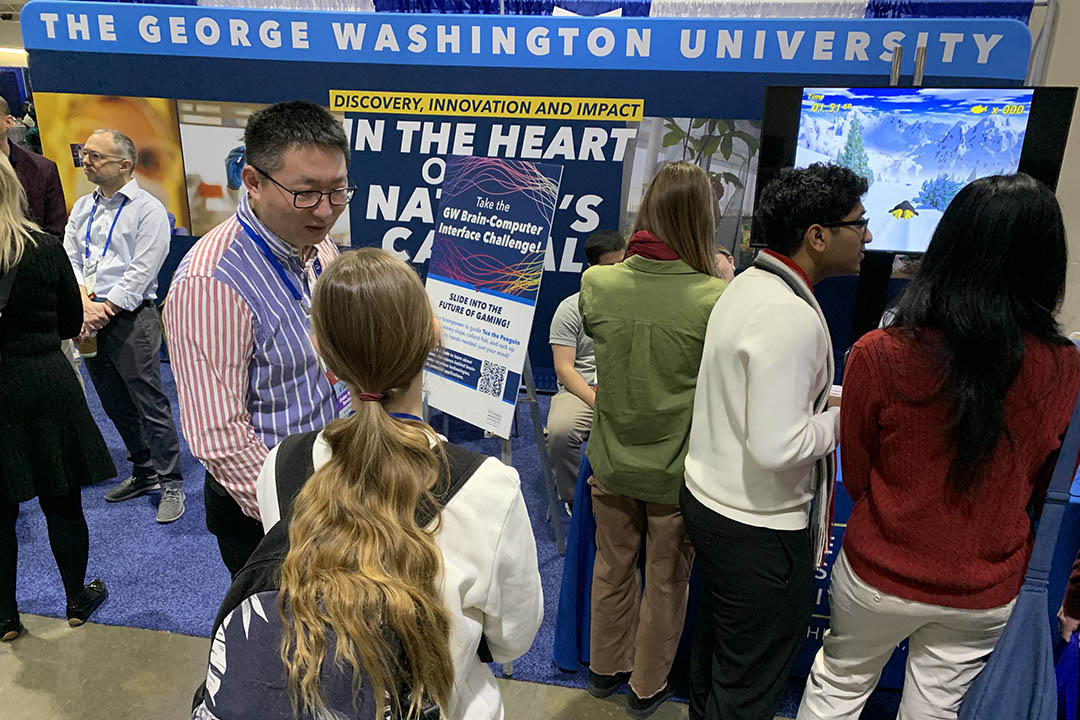


From an emotion-sensing robot dog named Arty to a hands-on creative activity led by art therapy experts, the George Washington University brought energy and thought-provoking insights to the 2026 American Association for the Advancement of Science (AAAS) Annual Meeting in Phoenix, Arizona.
As one of the world’s largest multidisciplinary science societies, AAAS draws more than 4,000 researchers, students, science journalists, foundations and government agencies from over 65 countries to its annual meeting.
This year, GW’s role as a conference sponsor placed the university front and center on the Sci-Mic Stage, where Holden Thorp, editor-in-chief of Science and a professor of chemistry, joined Richard Grinker, professor of anthropology and international affairs, and Gabriela Rosenblau, associate professor of cognitive neuroscience, for a timely and wide-ranging discussion titled, “Reclaiming Science in the Neurodiversity Debate.”
Drawing on decades of research on mental illness and neurodevelopmental conditions across cultures, Grinker emphasized that the recent rise in public concern over autism diagnoses reflects social and diagnostic changes rather than a new epidemic. Rosenblau added insights from her work on social learning with neurodivergent individuals, including her research with autistic children and their families, to illuminate current findings on intervention and support. Thorp, who has written publicly about his own late-in-life autism diagnosis, guided the discussion.
Together, the panel dispelled common misconceptions about neurodevelopmental disorders and focused the conversation on what the evidence actually shows: that neurodiversity has always existed, that support systems are essential, and that meaningful inclusion benefits everyone.

In the expo hall, GW’s booth was hard to miss.
Arty, a four-legged robot dog designed and programmed by faculty and students in GW’s Department of Biomedical Engineering, interacted with attendees of all ages (and species). Arty is no ordinary robot: the four-legged companion is being trained to sense and respond to human emotions, advancing research into how technology can better support neurodivergent individuals.
Leading the engineering group was Chung Hyuk Park, an assistant professor of biomedical engineering whose lab houses Arty, alongside graduate students Keuntae Kim and Zannate Malik, who have been instrumental in developing Arty’s sensing and response capabilities.
For Kim and Malik, explaining their research to a general audience at AAAS was as rewarding as the technical work itself.
"Arty rarely leaves our research lab, so the conference provided a valuable opportunity to showcase Arty's work to a broader audience and receive diverse reactions and feedback,” Kim said. “It was a meaningful experience and became a significant learning opportunity for both me and Arty."
Malik echoed that sentiment.
“It was a meaningful experience to showcase Arty and talk with attendees about how socially assistive robots can help people who struggle with social cues learn to recognize emotions and communicate feelings beyond words,” she said. “Attending AAAS also gave me a broader perspective on how our work connects across domains, and I was proud to represent GW Engineering while highlighting where assistive robotics and technology can help bridge educational gaps.”
Just steps from Arty, a different kind of science was on display. Jordan Potash, associate professor in GW’s Art Therapy Program, alongside graduate students Sarah Ort and Jiawei “Roxanne” Cen led conference attendees through a hands-on zine-making activity designed to transform and navigate stress through the power of art therapy.
Visitors created their own zine, a one-of-a-kind booklet, as a way of exploring psychological flexibility: the capacity to approach difficult feelings with openness rather than avoidance. It’s a concept central to Potash’s research and to the growing body of evidence supporting art therapy as an evidence-based health intervention.

"We knew that academics and researchers have been dealing with a lot of stress as a result of funding shifts,” Potash said. “Still, we were a bit taken aback by how many participants expressed appreciation for attention to their well-being. Hundreds of people took a zine to work on later and more than 50 people took time to sit at the booth to work on it."
Ort and Cen guided a number of attendees through the activity.
“Showcasing art therapy at the AAAS conference was a meaningful chance to connect creativity and research,” Ort said. “Engaging people in art making sparked important conversations about healing as it bridges resilience and innovation within the interconnected fields of science and art therapy. For many participants, this was their first introduction to our amazing practice, and I was proud to represent GW and further the interdisciplinary dialogue.”
"It was an incredible experience representing GW and the Art Therapy Program at the AAAS meeting,” Cen said. “I was glad we could offer insight into the practical applications of art therapy, build meaningful connections through the creative process, and bring themes of human experience and mental health to the science community."
The juxtaposition of Arty and the art therapy activity at the same booth was not coincidental. Both projects reflect GW's commitment to centering human well-being in its research, whether through technology, creative expression or the space where those approaches converge.
“GW's presence at this year’s AAAS Annual Meeting reflects a partnership that has grown meaningfully in recent years and continues to open new avenues for collaboration,” said Interim Vice President for Research Robert Miller. “We look forward to expanding the ways we work with AAAS to advance discovery and innovation for the public good.”
Beyond OVPR’s sponsorship of the meeting and the university’s status as an AAAS founding institutional member, AAAS has also participated in GW’s InnovationFest, bringing the two institutions together on GW’s Foggy Bottom campus.