

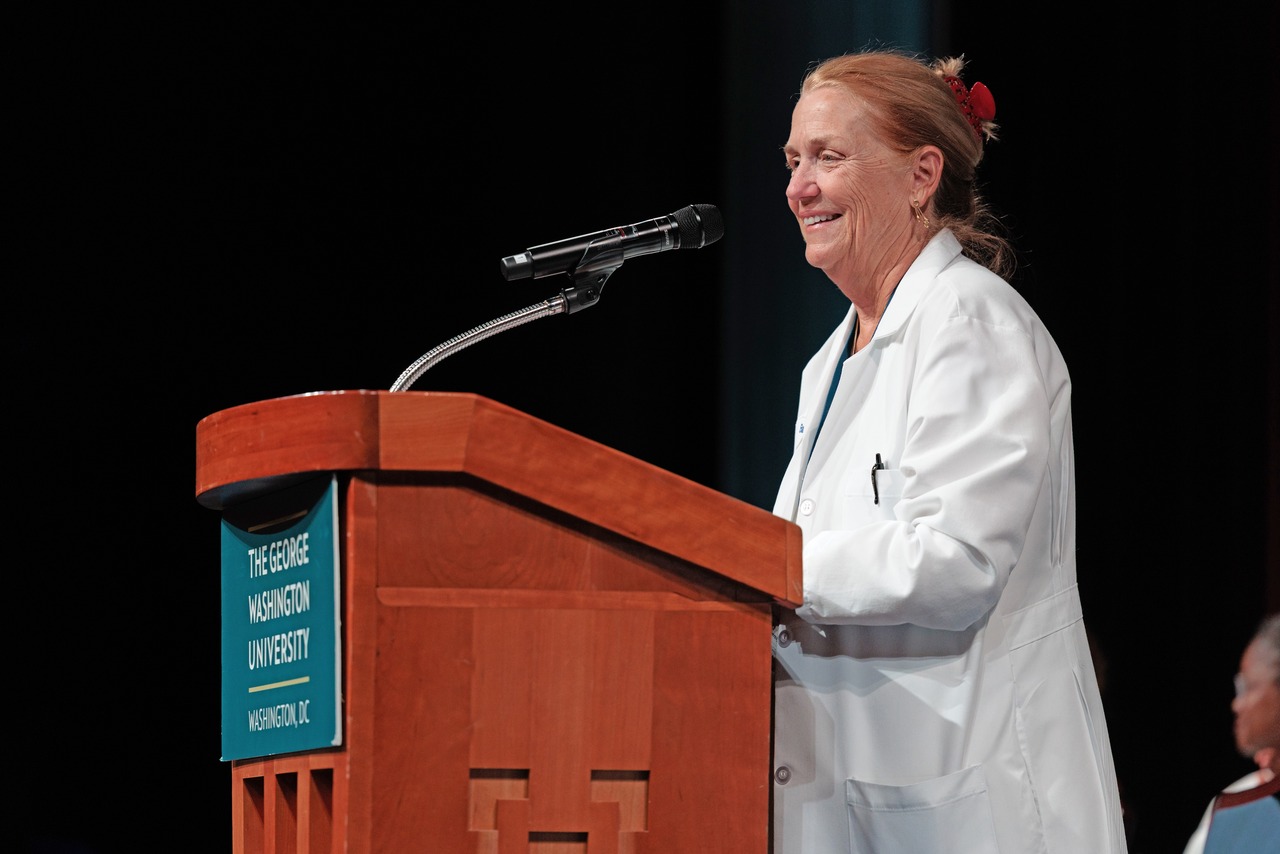
Barbara Lee Bass, vice president for health affairs, dean of the George Washington University School of Medicine and Health Sciences (SMHS), Walter A. Bloedorn Chair of Administrative Medicine and professor of surgery, announced her decision to retire, effective Feb. 28. Her departure concludes six years of leadership during one of the most consequential periods in the school’s 200-year history. An interim dean will be announced later this week.
In January 2020, Bass returned to GW, where she trained as a general surgeon from 1979 to 1986, becoming the first woman to serve as vice president for health affairs and dean of SMHS. She brought with her more than three decades of leadership in academic surgery as an internationally renowned surgical oncologist, educator and investigator.
“The opportunity to return to this wonderful institution to serve our cherished missions of advancing education, patient care, science and knowledge—embedded in our special GW sense of community service and equity—drew me back.” Bass recalled.
“Dean Bass represents the very best of GW, from her training as a resident to her remarkable leadership as vice president and dean to her deep commitment to improving human health here in the District and beyond,” said GW President Ellen M. Granberg. “At the start of her six years leading the university’s health affairs and SMHS, Dean Bass rose with her team to meet the challenges of COVID, and since then she has continued to bring the strategic vision, responsiveness and resilience that have strengthened the entire academic medical enterprise. As the university moves forward in its third century, Dean Bass will stand as a transformational leader, and the university will remain grateful for her service.”
During her tenure, Bass guided SMHS through the public health emergency and enduring aftermath; institutional, clinical and educational reorganizations; strategic planning and growth; and a historic bicentennial celebration.
“I am so grateful for the strength and exceptional skills of our people organization-wide,” Bass said. “I am especially gratified by the wisdom and guidance of my leadership team across the academic medical enterprise. They are talented and committed leaders who bring vision and innovation to their roles.”
Building leadership and resources
Strategic recruitment, retention and leadership development have been central to Bass’s service to GW. She strengthened the academic medical enterprise, attracting nationally and internationally recognized academic leaders across clinical, health science and basic science departments and decanal roles.
To reinforce long-term academic investment, Bass oversaw the installation of 17 endowed professors and chairs. She herself was formally installed as the Walter A. Bloedorn Chair of Administrative Medicine in 2022. Recruiting a distinguished cohort of department chairs and leaders, she noted, advanced her goals of strengthening the school’s education, research, clinical care and equity missions.
To help fuel the investments in people and programs, Bass partnered with University Advancement to raise more than $80 million for SMHS, securing 17 principal gifts of $1 million or more, including $17 million specifically for scholarships.
Leading through crisis
Within weeks of her return to Foggy Bottom, COVID-19 spread across Washington, D.C., and beyond. Bass pivoted, setting aside an ambitious slate of plans to coordinate the school’s emergency response across education, research and clinical operations.
In early March 2020, before the university suspended in-person instruction, Bass convened town halls to address the clinical impact of COVID-19 and its operational implications. Panels of GW experts guided the community through evolving decisions on telework, online learning and patient care.
“During that time, I was struck by the knowledge, expertise and high-performing operational responsiveness of our faculty and staff,” Bass recalled. “Despite the wicked challenges this deadly new disease presented, our teams didn’t blink. We developed support structures, information sources, and new systems to provide care and education. It truly was a remarkable shared effort with many heroes.”
SMHS and The GW Medical Faculty Associates managed university-wide testing programs, and the Vaccine Research Unit participated in national mRNA vaccine trials, enrolling volunteers in the Moderna Phase III trial and later supporting Sanofi and Omicron-variant studies. Once those vaccines received emergency use authorization, faculty, students and residents helped vaccinate thousands across the city.
“The pandemic, more than anything else, demonstrated the strength of our people and their adaptability and resilience,” Bass said.
A lasting positive outcome emerging from the period was the creation of the GW Resiliency and Well-Being Center, which provides critical support for SMHS and other colleagues amid heightened professional demands, a valuable resource that has only continued to grow.
Strategic direction and growth
In 2020, Bass launched a comprehensive strategic planning process culminating in the 2023–26 Strategic Plan, supported by four pillars: education, research, clinical care and population health and health equity.
The plan sets goals for local, regional, national and international recognition for excellence. The pillars are based on a foundation of shared values guiding decision-making and implementation: building community wellness, championing equity and inclusion and fostering a welcoming and supportive environment for learning and operations for all.
Growth came in a more literal sense as well, with the launch of the Regional Medical Campus (RMC) at Sinai Hospital of Baltimore, part of the LifeBridge Health System—an initiative conceived during the tenure of former SMHS Dean Jeffrey Akman. The campus offers GW third- and fourth-year medical students the opportunity to learn in a community-focused health system during the clinical phase of their training.
Research impact
Research in discovery and translational science at SMHS hit new heights during Bass’s tenure. Research expenditures for cancer biology, neuroscience, HIV/AIDS and vaccine science, among others, increased by 50% over five years, the highest level in the school’s history. That expanding research portfolio helped fuel GW’s ascendance to the Association of American Universities, North America’s premier research institutions.
SMHS secured its first National Institutes of Health (NIH) T32 training awards supporting the GW Cancer Biology Training Program and HIV/AIDS research training initiatives, a reflection of the school’s research strength. These grants bolster the pipeline of Ph.D. researchers and clinician-scientists at GW by supporting graduate students, postdoctoral fellows and early-career researchers as they develop into independent investigators. A third T32 award for postdoctoral health professionals studying biomedical and behavioral health research in primary care expanded the school’s emerging portfolio in health services research.
Supporting career pathways in science and clinical medicine has been a consistent priority. In 2021, Bass’ team established the Office of Clinical Research, which provides pre- and post-submission support for faculty pursuing clinical and translational research. The office expanded clinical trial capacity for faculty in a dozen departments across the GW medical enterprise and strengthened core research facilities.
Advancing academic missions
Under Bass’s direction, the institution strengthened core mission areas and modernized key programs across many departments and programs, building on prior excellence in clinical care, basic science and health sciences. Key recruitment of distinguished leaders across a number of clinical and basic science departments established a foundation for future growth, and those investments have already begun to pay dividends.
SMHS launched the Center for Population Health and Health Equity to build health services research and education capacity and advanced data-driven strategies to improve community health. The GW Cancer Center expanded during Bass’s tenure with a new director who launched GW’s first Phase I immunotherapy trial and established an operational GMP cell therapy facility to produce targeted therapeutics for patients.
More than advancing GW’s reputation, these developments enriched the learning environment and made a meaningful difference for patients and communities, especially in the District. GW’s community partnerships aligned with the opening of the Cedar Hill Regional Medical Center and the GW Cancer Prevention and Wellness Center. Together, these efforts brought care closer to historically underserved residents of Wards 7 and 8.
Accreditation milestones further reflected the school’s progress. The MD program and the Physician Assistant Studies program both earned top accreditation from their respective oversight bodies. The school also launched an entry-level Occupational Therapy Doctorate program, graduating its first class in May 2025.
“Providing outstanding educational opportunities for our exceptional students, residents and fellows has been a great source of pride and joy,” Bass said.
Celebrating two centuries, building for the next
From January 2024 through March of 2025, SMHS celebrated its bicentennial. During that 15-month span, the school hosted 17 signature events that raised awareness about the school’s rich history and amplified the many accomplishments of its people and programs, past and present.
From inspirational guest speakers through programs like GW MED Talks to highlighting the work of outstanding faculty through the Faculty Lecture Series to sharing GW’s medical expertise, the SMHS bicentennial was a strong platform to both celebrate its distinguished history and build the school’s third century.
A career built on experience
Bass earned her medical degree from the University of Virginia and was inducted into Alpha Omega Alpha honors society. She completed her residency in general surgery at GW in 1986, becoming the first GW resident to pursue a research fellowship during her surgical training as part of the surgical research unit at the Walter Reed Army Institute of Research. The experience, she said, propelled her career in surgery, academic leadership and discovery and translational research. To secure the coveted fellowship, Bass joined the United States Army as a commissioned officer, serving as a captain in the U.S. Army Medical Corps, a decision she called one of the most gratifying periods of her career.
Over the next 30 years, Bass led research programs in gastrointestinal cell biology, computational surgery, health services and surgical oncology, funded by NIH, the VA Research Service, the European Union and the National Science Foundation.
Her academic roles have included appointments to NIH study sections, editorial leadership for academic journals and service as the chair of the board of directors of the American Board of Surgery and other academic surgical societies. Bass also served as president of many national surgical professional and academic societies, including the American College of Surgeons, and she has been recognized with honorary fellowships in colleges of surgery around the world.
In her last position prior to returning to GW, Bass served as professor of surgery at Weill Cornell Medicine and chair of the Department of Surgery at Houston Methodist Hospital. In Houston, she founded the Methodist Institute for Technology, Innovation, and Education—a state-of-the-art simulation center that has trained more than 70,000 health care providers and has set the standards for simulation-based training and assessment for technical retooling and privileging for surgeons in new technologies.
As a pioneering woman surgeon in academic medicine, she has been a tireless advocate for equity in medicine, championing opportunities for women and underrepresented minorities in health care careers, work which has earned her national and international honors. Over 40 years of clinical surgical academic practice, Bass cherished surgical residents, contributing to the training of hundreds of surgeons, many of whom are now serving as academic leaders across the country for the benefit of human health.
“I was a practicing surgeon for 40 years. If there is one part of my professional life that I have missed in these past six years, it has been my patients,” Bass said. “The personal bond of caring for a patient is the greatest of privileges that I have had over the course of my career.”
After six defining years, Bass leaves behind an academic medical enterprise shaped by resilience, strategic focus and a renewed commitment to science, education and community health.
“I am deeply grateful for having had the opportunity to serve this remarkable community,” Bass said.