

It was a muggy, ominous August Sunday in Washington, D.C., but Sabrin Ahmed and Arooj Vahora barely noticed the weather. The two George Washington University students were running point on a major meal giveaway activation in the city’s Columbia Heights neighborhood, the culminating event of their summer internship in response operations at World Central Kitchen (WCK). They’d been working with local partners, finalizing the menu (a spinach parmesan pasta and chicken adobo over rice), procuring ingredients and physically packing up kitchen trucks in the organization’s massive Response Operations Center (ROC) warehouse.
Now that the day was here, with cooks bustling in the trucks and hundreds of people waiting for meals, the duo simply didn’t have time to notice the increasingly threatening skies.
Until the clouds opened.
“When it first started raining, I had this little hat on and I was like ‘I’m untouchable, this rain is not going to get to me,’” remembered Ahmed, a rising junior double majoring in business and human services as part of the combined B.A. in Human Services and Social Justice/M.P.A. program at the Trachtenberg School of Public Policy and Public Administration.
But that day would be D.C.’s wettest of 2026, with monsoon-like waves of rain depositing up to three inches of water across the region. Against the deluge, Ahmed’s hat wouldn’t protect much more than her forehead. “At some point I looked down at myself and I was drenched. My pants were soaked. Everything was gushing water.”
Vahora, a rising senior in the Elliott School of International Affairs, was equally sopping. The two—who refer to themselves as “peas in a pod”—looked each other up and down. Then they plunged back out into the storm, armed with spare ponchos for the families waiting.
“Everyone was like, ‘Are you guys crazy? What are you doing?’” said Vahora, smiling at the memory. “We were like, ‘Well, people need to get fed, people need warm meals. We’re only here because of them.’”
“Being in that rain, getting drenched and still seeing a smile on people’s faces, was such a transformative experience,” Ahmed said. “That’s why people do this work, and this is what I want to do.”
That transformative experience was made possible by GW’s Humanitarian Internship Program (HIP), a 10-week professional internship opportunity that empowers students to contribute to global and local humanitarian efforts.
Through the President’s Fund for Excellence (PFFE)—a donor-funded discretionary fund that enables GW President Ellen M. Granberg to direct funds for maximum impact—30 students, including Ahmed and Vahora, received stipends to pursue humanitarian positions at 11 organizations.
“These opportunities and the continued growth of the program would not be possible without the generosity of donors, whose support has been essential to making these transformative experiences a reality,” Assistant Director of Strategic Initiatives and Engagements in the Office of the President Jack Hatcher said.
Celebrating ‘ambassadors for GW’
WCK, which employed the summer’s largest contingent of 12 interns, hosted a celebratory reception for all HIP participants Aug. 8 at its D.C.-area ROC in Capitol Heights, Md.
In the vast space, surrounded by pallets of food and the massive vehicles that help WCK deliver it, HIP interns shared a meal, laughed and reminisced while mingling with each other and with representatives from GW, WCK and other partner organizations.
Granberg thanked the HIP students for being “amazing ambassadors for GW.”
“When I originally proposed [HIP], I had no idea what this could become,” Granberg said. “I had the idea that…we should make it possible for students to do summer internships with humanitarian organizations, and that money shouldn't be a barrier.”
But through the work of the program’s first two cohorts and the staff who organized them, Granberg said, HIP has had an even more powerful impact than she imagined.
“I hope I'll get to see some of you in humanitarian careers as you move forward,” she said.

Speakers from WCK echoed the sentiment. “Thank you to GW and the Humanitarian Internship Program," WCK Chief of Strategic Relations and General Counsel Aaron Renenger said. "When I looked out at our interns this summer, I saw commitment, I saw heart, I saw an entrepreneurial spirit, I saw a mission-mindedness, and from that derived encouragement that the future of the humanitarian sector is in good hands."
Associate Vice Provost for Career Services Kelley Bishop emphasized both the work of individual HIP students and the centrality of partner organizations and people.
“We know from the testimonials of our students just how meaningful these internship experiences have been,” he said. “Interns learn not only what it takes to run an organization, but also what motivates you to advocate for others and show up when people are in need. They've grown from your example.”
Big responsibilities, bigger rewards
Across a range of assignments—including cleaning up data infrastructure at Engineers Without Borders, shaping communications strategy at Project HOPE and more—HIP interns said the experience was characterized by the deep relationships they formed and the serious responsibilities with which they were trusted.
Martina Croce, an Elliott School M.A. student whose dream is to work for the United Nations, spent the summer at a HIP-funded UNICEF internship. Aware of the massive size and global reach of the children’s aid organization, Croce felt “honored and very grateful” for the opportunity but told herself not to expect too much responsibility or high-level work experience from the summer. Whatever she spent those 10 weeks doing, she decided, she’d be proud to give it her all.
Then, in the second week of her internship, Croce’s supervisor came to her with a multimillion-dollar funding proposal. Her new assignment was to work out the budget, review it and prepare it for submission to the U.S. State Department. It was almost the weekend; the proposal was due Monday.
“‘Wait—me?’” Croce remembered saying.
Croce’s supervisor, who Croce called “a real mentor,” reassured her and walked her through the process, then left her to it. Croce buckled down and spent the weekend on the complex process of budget review, refinement and revision. The proposal was submitted on time, and Croce leapt into the next project.
A few days later, Croce had her headphones in, streaming a live feed from the UNICEF Executive Board Annual Session while she worked on something else. She was half-listening as a United States representative began to speak. Then she registered that they were announcing the U.S. had signed on to a $218 million UNICEF partnership. That was the amount named in the proposal Croce had worked on. It had been accepted.
She stopped working, stunned. The intense work she’d put in had mattered. A major aid package was going to reach real children who needed it.
“To be requested to do something like that, to be trusted and to be shown I could do it—I don’t think there is a better way to learn,” Croce said. “Going in, I knew I loved humanitarian aid but I thought maybe it was just an academic interest. This experience reaffirmed that it's a career choice, a calling. I leave this internship feeling so much more knowledgeable about what actually happens in humanitarian work.”
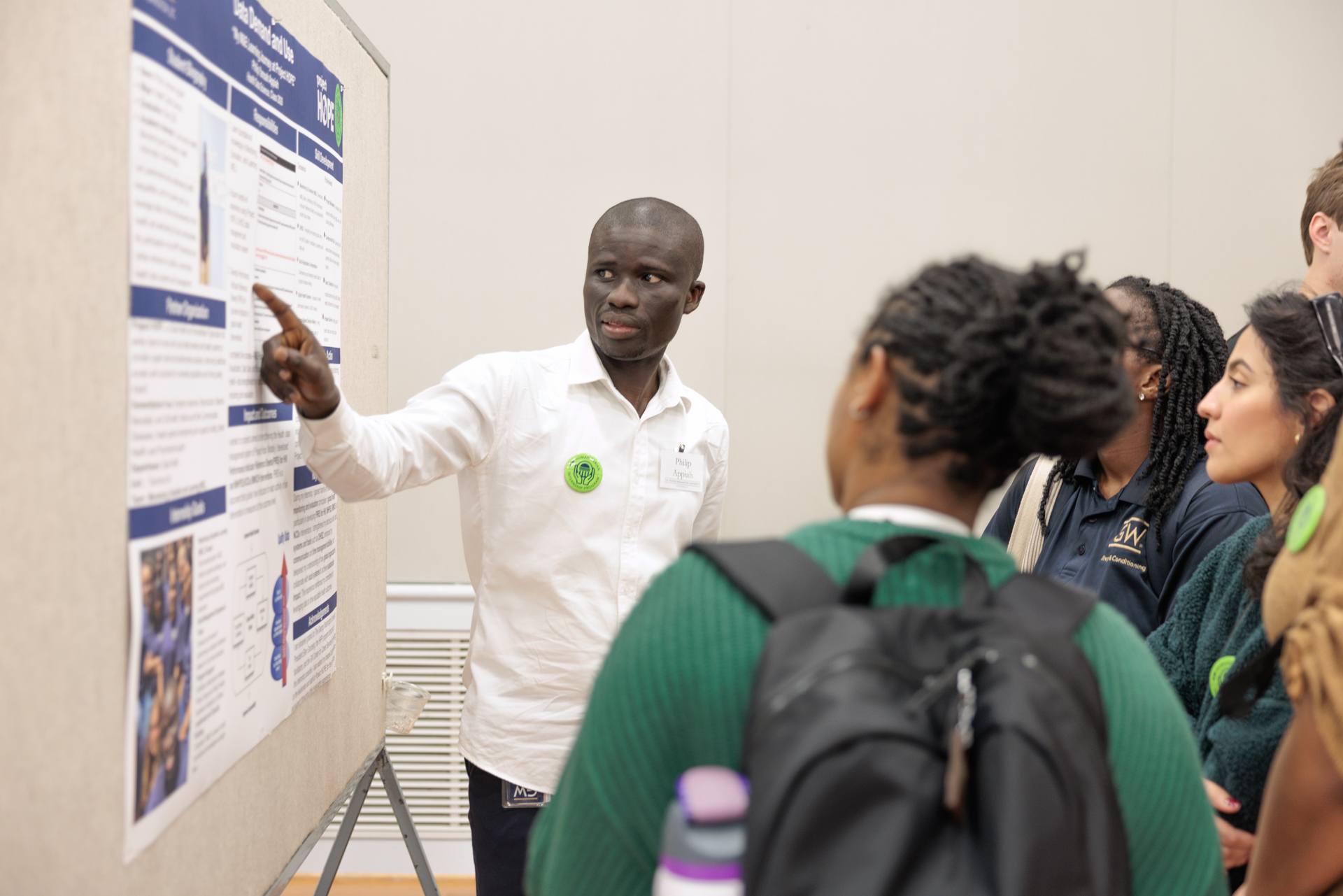
This year’s HIP participants will present their work at a poster presentation in the University Student Center Oct. 2. Interested in supporting future HIP difference-makers? Learn more here.