
Elizabeth Krutchen grew up spending summers between her home in Southern Indiana and her grandparents’ farm in Minnesota, watching her family of engineers apply themselves to all the problems that can arise in a complicated operation like a dairy farm or a family vacation—fixing a tractor, starting a motorboat. At around the age of four, she remembers pulling out her parents’ toolbox to fix a bracelet her brother had broken.
“I always grew up with the engineering mindset, with that approach to solving things,” Krutchen said.
That mindset eventually led her to the Clark Scholars Program at the George Washington University School of Engineering and Applied Science, where she is now a third-year student majoring in civil and environmental engineering. Krutchen volunteers with Engineers Without Borders, interned with local government in her home state of Indiana and with utility company CenterPoint Energy and recently studied abroad in Ireland. She has worked on stormwater pollution prevention plans and land remediation and has investigated how coal-fired power plants like those in her home state can convert to greener energy.
Krutchen credits much of this work to the Clark Scholars Program, which provides GW engineering students with financial assistance, leadership experience and opportunities for professional development and networking.
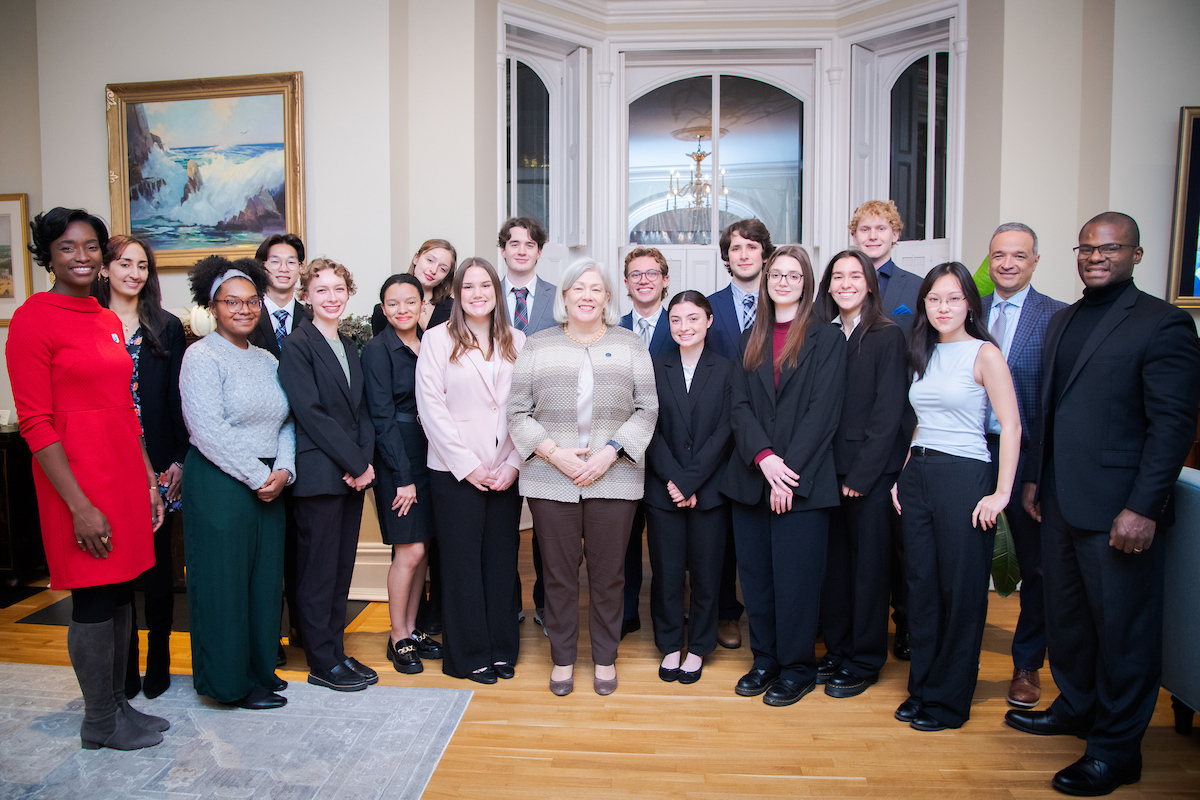
“I wouldn’t even be here, at GW or in D.C., without Clark,” Krutchen said last month at GW’s F Street House. She and other Clark Scholars were guests at a dinner hosted by President Ellen M. Granberg and her wife, Sonya Rankin, in honor of the recent transformational investment of $11 million from the A. James & Alice B. Clark Foundation. The program “has opened so many doorways for me that I never could have imagined three years ago.”
At the dinner, Clark Scholars and academic and administrative leaders from GW exchanged stories and shared their gratitude with representatives from the Clark Foundation.
“The Clark Foundation represents an amazing set of values around opportunity, hard work, integrity and respect,” Granberg said.
The many Clark Scholars Granberg has met during her time at GW “embody and carry forward” those values, she said.
Three cornerstone principles—servant leadership, impact through engineering design and legacy beyond the classroom—define the program and the students who are part of it, Clark Scholars Program Faculty Director Royce Francis said.
“The key things that make the Clark Scholars stand out to me are their leadership, passion for impact and the diversity of backgrounds, majors and professional interests involved in our community,” Francis said. “I have been blessed to reflect every day on how they make the culture in the School of Engineering better. Their presence in every area of our school, academically and co-curricularly, provides opportunities for synergies among the group to emerge and amplify their positive impacts on GW Engineering as a result of this scholarship program.”
For many students, the Clark Scholars Program is transformational in its ability to break down boundaries between disciplines and institutions, providing scholars with opportunities and connections not available to most undergraduates, especially in the sometimes-siloed world of engineering. And the program provides monthly check-ins, a chance for its high-achieving participants to connect and take a breath.
Clark Scholars are “a community,” said Andrei Khudiakov, a second-year mechanical engineering major. “It’s a lot of like-minded, hardworking, dedicated people. Usually I find myself in mechanical engineering circles, but this expands to all different kinds of engineers, so I get to meet new people who want to do cool things.”
Several attendees of the dinner had recently returned from a weekend summit at Duke University, where they met Clark Scholars from other universities—fellow engineers whose interests and strengths differ, but whose commitment to the program’s values provide a point of commonality and an opportunity to build professional skills.
“We did service--giving back to the community is a big part of it--but it was also a great networking opportunity, so we got to practice the business side of engineering, make proposals and give presentations,” said Briana Sisler, a second-year student majoring in computer science. “It was just very useful.”
Sofiia Khugaeva, a senior majoring in biomedical engineering and health equity, noted that the Clark Scholars Program helped her to focus on the kind of engineer she aspires to be. Khugaeva, who moved from Russia to the United States as a high school student, is an archetypal Clark Scholar: a regular volunteer with local nonprofit Miriam’s Kitchen, a recent winner of the Knapp Fellowship for Entrepreneurial Service-Learning and an assistant to Francis in designing the engineering service-learning course enabled by the Clark Foundation’s latest investment at GW. For her senior year capstone project at GW Engineering, Khugaeva and her team are working with a doctor of emergency medicine at the University of Maryland to design a device enabling faster and more efficient intubation—a real-world intervention that could save lives.
“As a biomedical engineer, I want to develop devices that help people live longer and healthier lives,” she said. “But beyond that, I also want to be an entrepreneur to start companies that drive innovation, but also make sure that part of the profit always goes back to the community.”
“We see the Clark Scholars as talented engineers who will enter the workforce with strong technical skills and a commitment to leadership and service,” said Joe Del Guercio, president and CEO of the A. James & Alice B. Clark Foundation. “While the Foundation will sunset at the end of 2025, we are confident these Scholars will carry forward the vision our founder Mr. Clark set for this program and continue strengthening their communities for years to come.”