

If you’ve ever been to an office or department holiday party, you may have seen the way a room full of people tends to arrange itself in predictable patterns: friends next to friends, least-favorite coworkers ignoring one another. Say a small subgroup of party guests were new to the workplace and didn’t know many people. Would they scatter randomly throughout the room? Or would they, too, tend to fall into predictable configurations—near circles of extroverts, say, or around the snack table?
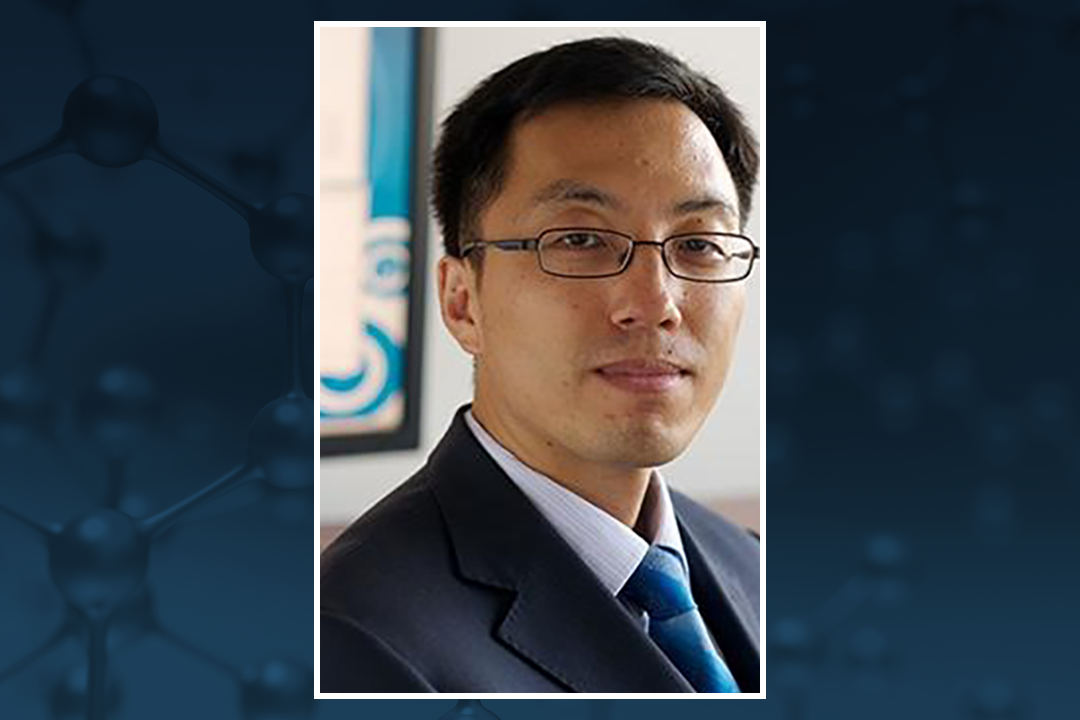
If so, they would demonstrate the existence of short-range order, or SRO. And if these weren’t party guests, but atoms in an alloy comprised of multiple elements, the existence of SRO in their arrangement would mean a paradigm shift for computing. That’s the possibility raised in a recent paper co-authored by Tianshu Li, a professor of civil and environmental engineering at the George Washington University School of Engineering and Applied Science, published September in Science.
The research, conducted in collaboration with the Lawrence Berkeley Lab at the University of California, Berkeley, found that atoms within semiconductor alloys of germanium, silicon and tin arrange themselves in distinctive local patterns, or “atomic neighborhoods,” that dramatically affect the behavior of the material. That discovery opens the way to manufacturing novel materials capable of handling next-generation technology, including quantum computing and neuromorphic computing, with a new degree of efficiency and power.
“This is the first time that we have been able to visualize the subtle patterns that atoms adopt in semiconductors,” Li said.
Previously, Li said, the general assumption has been that atoms in an alloy arrange themselves at random. But he and a few other researchers have long predicted that SRO exists and could be proved experimentally.
For Li, this conviction came from spending a decade studying nucleation, or the transition between thermodynamic phases, in water turning to ice. In liquid water, H2O molecules exist in a chaotic, apparently random state; in ice, these same molecules order themselves in tidy crystals.
“One thing that I've learned is that many so-called ‘disordered’ systems, like water, are not truly disordered,” Li said. “Behind this seeming randomness, there is actually a subtle pattern, and that subtle pattern itself is critical for the nucleation or crystallization process. So, I've always had this mindset that truly random systems are really rare.”
To investigate that prediction, Li and a multidisciplinary team of experimentalists and theorists established the Center for Manipulation of Atomic Ordering for Manufacturing Semiconductors (µ-ATOMS), which was awarded more than $10 million as a Department of Energy (DOE) Energy Frontier Research Center. Its purpose is to demonstrate three key assertions: that SRO exists, that it matters, and that it can be controlled for technological applications.
These are not easy claims to prove. Even a tiny alloy sample contains millions of atoms. Pinpointing the exact location of each, as any proof would necessarily have to do, is a tremendous ask.
Collaborator Andrew Minor, a professor of materials science and engineering at Berkeley and facility director of the National Center for Electron Microscopy, is a pioneer in cutting-edge electron microscopy. But even the most advanced equipment cannot isolate every single atom in an alloy. The team would need to use computer modeling to interpret the characterization data provided by microscopy.
So, Li and his team developed an advanced machine-learning model capable of simulating millions of atoms, replicating the scale of Minor’s techniques. That synergy—investigations of a physical sample confirmed and expanded upon by the virtual model—provided enough clarity to identify specific structural motifs demonstrating SRO.
“We could simulate a diffraction pattern that matched the experimental pattern, and that allowed us to tell not only that there was short range order, but also the correlations that created this diffraction pattern,” Li said.
To explain why this discovery could be technologically game-changing, we might return to the crowded holiday party. Say you wanted a piece of juicy office gossip to spread through the room—including your new coworkers—in the shortest possible time. If you could predict the exact patterns of proximity into which the crowd would fall, you would be able to pinpoint the swiftest path along which to move the story. In fact, if you knew the preferences and behavior of each type of partygoer, an extremely well-informed planner could set the venue up for maximally efficient gossip distribution, right down to the arrangement of chairs and punch bowls. Alternatively, this office Machiavelli could tailor the invitations so groups of useful people are introduced into the party at particular times, or through particular entrances, in ways that ensure the flow of conversation.
It’s not a perfect metaphor, but the movement of a story from one party guest to another does resemble the way an electrical signal moves through a semiconductor. Like the diabolical party planner in this hypothetical, an engineer who understood SRO in the alloy they were using could adapt their material for maximum efficiency.
The potential applications for such short-range engineering are manifold, Li said. Semiconductors are the backbone of modern life, and the traditional approach to improving them has been to change their composition or structure. But SRO provides a new approach. Materials produced with SRO in mind could change the way data is stored and retrieved, allowing for more powerful and efficient computing. Or they could vastly reduce the energy consumption of AI data centers, which by 2030 are predicted to account for about 20% of global energy use.
For Li and his team, the next step is to push outward: to see if SRO exists in alloys other than germanium-silicon-tin and also to investigate techniques by which engineers could take advantage of it, either at the beginning of production (by changing the way the materials in the alloy are mixed) or by post-processing.
Wherever their next investigations take them, Li said, this paper proves the importance of interdisciplinary collaboration and digging deep into received wisdom. He and his team first posited the existence of SRO in semiconductor alloys around 2019. Proving it “took a very long time,” he said, but seeing their prediction come true is electrifying.
“The significance of this is that we found there is a hidden order,” Li said. “And not only [is] the hidden order itself fascinating, but it can be extremely useful and can become a new engineering approach. That’s what inspires me.”
